January 22, 2008

meatball sundae [part two]

11444661502zzzzz6-thumb.jpg

Recently I did an interview of Seth Godin about his new book, "Meatball Sundae". As Seth described it:

Meatballs are commodity products, built in a factory, advertised all over. Stuff we need. All the same. Average products for average people. Unremarkable, but important. The backbone of our world so far.

The sundae is the new marketing. Blogs and Facebook and google and crowdsourcing and all the stuff that we get excited about. It works great if you've got a social object or a purple cow. But put the sundae on a meatball and...

There's a passage in the book that really got me thinking, all to do with ice cream:
Willie Wonka isn’t dead, but he’s bald

In the heart of the newly hip Union Square neighborhood in New York City is a brand-new landmark: Max Brenner [Chocolate by the Bald Man]. Max (I’m told that's not his real name) purportedly runs a chain of incredibly expensive chocolate cafés based in Australia. He’s got almost a dozen shops there, with other outlets in Israel, Singapore, and the Philippines. The chain is profitable and growing fast.

This is the place to come if you want to order the Warm Chocolate Soup, which comes with crunch chocolate waffle balls, strawberries, and marshmallows and costs ten dollars. Or, for the ambitious, The Chocolate Mess, which is a warm chocolate cake eaten with spatulas straight from the pan, with a mountain of whipped cream, ice cream scoops, chocolate chunks, toffee cream, warm chocolate sauce, and possibly, toffee bananas. It’s $12.75 for one person or $37 for four.

Max’s is packed, with lines of up to thirty minutes for a table. And most tables are filled with adults, not kids.

Just down the street from a Max’s, you’ll find the much more reasonably priced Sundaes and Cones ice cream shop, which is pretty much empty.

Why?

If I want something ordinary, then it better be cheap. I can get cheap and ordinary by the gallon at Costco. On the other hand, today’s spoiled consumer is willing to pay almost anything for the exclusive, the noteworthy, and the indulgent.

Sundaes and Cones isn’t cheap and it isn’t expensive. The ice cream is delicious, but not revolutionary. They sell a good ice cream cone at a fair price. And that’s no longer enough.

A couple of days ago I wrote Seth the following e-mail:
Suddenly the thought occurs to me, that perhaps there'd be fewer 'Meatball Sundaes' out there if the Web 2.0-consultant-guru types spent less time trying to sell lucrative, hot-fudge-and-whipped-cream consultancy gigs to the meatball factories.

[Ice Cream Metaphor:] The thing that made Thomas and English Cut work so well was, well, he's not selling meatballs. He's not even selling Baskin Robbins. Heck, he's selling something that makes even Ben & Jerries look kinda downmarket. And the hot fudge I bring to the table ain't too shabby, either. On a good day, at least ;-)

Your passage in the book about the two ice cream shops in Union Square was totally correct. The trouble is, too many people are locked into the mass-market, neither-cheap-nor-remarkable bracket, so they're not ready to listen to you properly yet.

I love your ideas, you know that, but I'm guessing it may take twenty, thirty, even fifty years for "Society" to fully absorb the brunt of your message. Luckily you have loads of smart, book-buying people out there who do get it...

We live in interesting times.

Seth wrote back to me the following:
THAT is the entire point of the book.

Phew! Someone got it!

Twenty years? Fifty years? Which is why Seth says what he's talking about is not evolutionary, but revolutionary. Make of it what you will...

Posted by hugh macleod at 9:23 AM | Comments (63) | TrackBack

January 7, 2008

note to marketers: people like treats, dammit!

zzzzazzdggg87777.jpg

It’s now a well-told story. Krispy Kreme doughnuts came out of nowhere, attracted a cult following, spread like wildfire, got over-exposed, then collapsed under its own weight. When I could only get them by making a half-hour pilgrimage across town, I went there all the time. Once they became readily available in my local corner deli, I stopped eating them.

When I was a little kid in central Massachusetts, there was this local, old-style dairy named Pinecroft, that served the best ice cream ever, but only during the summer months. Then the dairy got sold to a bigger company, and the next thing you know they were serving ice cream all year round. It never tasted quite the same after that.

Rosé tastes a lot better in the South of France than it does in London, no matter how much you’re paying.

Lobster is considered a real delicacy, expensive stuff. Back in the 19th Century in New England whaling towns, local boarding houses often had the following sign outside them, in order to attract the sailors' business: “Lobster only served 4 days a week!”

I only listen to my CD of King's College Choir during the Christmas holidays. It preserves the magic.

Scrimping and saving over many months for a $4000 English tailored suit is a much more uplifting experience than buying an entire wardrobe of them with a single swish of a diamond-encrusted credit card.

I rarely eat Barbecue, but it’s usually the first thing I head for when I travel to Texas. When I travel to different places, I always like to sample the local fare. I once tried eating Mexican food in Geneva. Never again.

Though they produced all three Lord of The Rings movies at the same time, they made you wait a year between installments. People flocked to see them all.

One of the things I am most looking forward to in 2008 is the final season of Battlestar Galactica. It will be well after summer till I see here in the UK, on DVD [I don't own a TV]. I'll probably buy it the same day it becomes available, and I'll probably watch the entire series in a single, marathon session. I can’t wait!

Back when Kathy Sierra was blogging, she wouldn’t post very often. Every two weeks, perhaps. But BAM! when she wrote, it was stellar stuff. A real treat to read.

I guess you can already see where this is going: People like treats. People are indifferent to commodities, even when the quality of the latter is high. Your downfall begins the minute people no longer have to wait in line in order to get your product, the minute they no longer perceive it as a treat.

[Update:] David St. Lawrence makes a great comment below: "When they are no longer social objects, they are no longer interesting." Exactly.

Posted by hugh macleod at 2:04 AM | Comments (20) | TrackBack

December 23, 2007

so what's all this new marketing stuff, anyway?

0712ifyoutalkedtopeople.jpg

Some people call it "The New Marketing". Some people call it "Marketing 2.0". Whatever name you care to give it, I get asked about it a lot. Here are some random thoughts, in no particular order.

1. "The New Marketing" came about because of two unstoppable forces: [A] The invention of the internet and [B] the beginning of the demise of what Seth Godin calls the "TV-Industrial Complex". Thanks to the internet, as Clay Shirky famously stated in 2004, "the cost and difficulty of publishing absolutely anything, by anyone, into a global medium, just got a whole lot lower. And the effects of that increased pool of potential producers is going to be vast." While this was going on, large companies found out that people were starting to ignore their ads. We have too many choices, too many good choices, and we've gotten too good at ignoring messages.

2. Seth Godin is quite rightly the world's most respected writer on marketing. That being said, a lot of people haven't heard of Mark Earls yet. They're both friends of mine, so I don't want to compare them too much. Seth is a master of taking complicated ideas and presenting them in a way that any Average Joe can understand. Mark is more of a Marketing Geek's geek. His stuff makes uncomfortable reading for anyone in marketing who hasn't been stretching himself lately.

3. The most important asset in The New Marketing is "having something worth talking about". This makes certain marketing people squeamish. A lot of us grew up in an era of flashy commercials for rather uninspiring products, and something in our DNA makes us believe that's the proper way to go about things.

4. If I had one big insight from the last year, is how The New Marketing has everything to do with how your product or service acts as a "Social Object". Kudos to Jyri Engestrom for turning me on to it.

5. My second big insight from this year was learning that, even with a fairly everyday product, you can create social objects simply by using your products to make social gestures. That's what we did with Stormhoek. The message wasn't, "Here's why you should buy our wine". The message was, "We think you're kinda cool, and we like what you're doing. We'd like to be part of it, somehow." And much to everyone's surprise, it worked rather well.

6. Blogs were the big story for 2005. YouTube for 2006. Facebook for 2007. What's the big story for 2008? I have no idea. Nor do I think it matters. For the big story, really, is always going to be the same. Websites comes and go, but "Cheap, Easy, Global, Hyperlinked Media" will be with us forever, save for Nuclear Holocaust.

7. A lot of what fuels The New Marketing is quite simply, the most important word in the English Language: "Love". It's hard to get someone to read your website if you're not passionate about your subject matter.

8. I'm trying to train myself to avoid "Microsmosis" i.e. mistaking of a microcosm for the entire cosmos. If you got all your news from blogs, you'd be forgiven for thinking that there are just two phone companies- Apple and Nokia. But Sony, Motorola, LG and Samsung sell a lot of phones, too. Just not to our friends.

9. My Definition of "Web 3.0": Learning how to use the web properly without it taking over your life. I'm not holding my breath.

10. Why is it so hard to explain The New Marketing to large companies? Because the people who work there are simply not prepared to relinquish the idea of control. Live by metrics, die by metrics etc.

11. I find all this more interesting when I don't take it too seriously. Like all things internet, it's far too easy to get carried away.

[UPDATE:] Robert Scoble leaves an interesting comment:

Friends are going to be the big story in 2008. Here's a post about why it's wrong that I'm a gatekeeper between my friends and you.


Posted by hugh macleod at 5:37 PM | Comments (16) | TrackBack

November 5, 2007

isolate [my new business card]

0711isolate.jpg

This is the design for my new business card [No, I am not joking].

Feel free to use it yourself [or any other cartoon on gapingvoid] for your own schwag- biz cards, t-shirts, cubicle posters, PowerPoint slides, whatever. As per usual, the full details and regular licensing terms are here etc. Or again, as per usual, you can order printed gapingvoid business cards here at Streetcards etc etc.

[Yes, "Isolate Their Pain Centers" sums up my whole Hughtrain marketing schtick pretty well...]

Posted by hugh macleod at 2:30 AM | Comments (5) | TrackBack

June 17, 2007

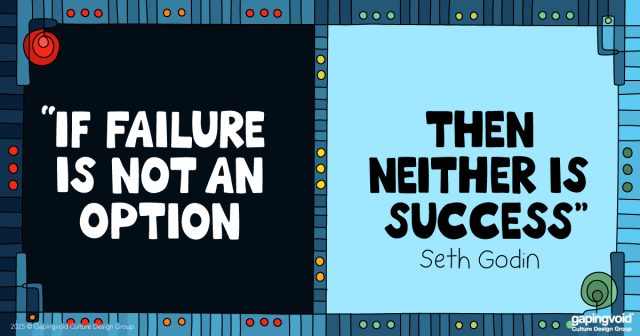
but what if i fail

fail444456.jpg
[One of the drawings I did for Seth Godin's latest book, "The Dip".]

Social Objects and Homeless People

So I've been thinking some more about Jyri's Five Principles of Social Objects, especially how they apply to gapingvoid:

1. You should be able to define the social object your service is built around.

In gapingvoid's case, that would be the cartoons for the most part. The straight writing part I'm less concerned about.

2. Define your verbs that your users perform on the objects. For instance, eBay has buy and sell buttons. It's clear what the site is for.

The verb that springs to mind is "share". Not only do people re-publish them on their blogs, they're also allowed to upload them onto other media for free: posters, t-shirts, stickers, whatever works for them. My licensing terms are pretty open.

3. How can people share the objects?

The key word here is "re-publish". Microsoft's Steve Clayton is probably the most well-known of my "re-publishers", as he's always using the Blue Monster cartoon for different things.

4. Turn invitations into gifts.

Again, the Blue Monster cartoon would serve as a good example. Microsoft employees hand out Blue Monster schwag as an invitation to start a conversation about Microsoft. The Blue Monster's main function is not about the message, the Blue Monster is about the social gesture.

5. Charge the publishers, not the spectators.

D'accord. The people who put the cartoons on their business cards are doing the paying, not the people receiving them.

Somewhere along the line I figured out the easiest products to market are objects with "Sociability" baked-in. Products that allow people to have "conversations" with other folk. Seth Godin calls this quality "remarkablilty".

For example: A street beggar holding out an ordinary paper cup cup won't start a conversation. A street beggar holding out a Starbucks cup will. I know this to be true, because it happened to me and a friend the other day, as we were walking down the street and a guy asked us for some spare change. Afterwards, as we were commenting about the rather sad paradox of a homeless guy plying his trade with a "luxury" coffee cup, my friend said, "Starbucks should be paying that guy."

Actually, my friend is wrong. Starbuck's doesn't need to be paying the homeless guy. Because Starbucks created a social object out of a paper cup, the homeless guy does their marketing for free, whether he knows it or not.

Although I suspect he does. I suspect somewhere along the line the poor chap figured out that holding out a Starbucks cup gets him more attention [and spare change] than an ordinary cup. And suddenly we're seeing social reciprocity between a homeless person and a large corporation, without money ever changing hands. Whatever your views are on the plight of homeless people, this is "Indirect Marketing" at its finest.

And of course, the way I market my cartoons and my other various enterprises is not all that dissimilar...

[Bonus Link:] A wonderfully thought-provoking podcast interview of Seth Godin. Disclosure: He kindly gives me a brief mention about 23.15 minutes into it.

Posted by hugh macleod at 1:24 AM | Comments (6) | TrackBack

June 4, 2007

2012 olympic "brand launch"

04062007418.jpg
[The paparazzi getting in their photo ops etc. Watching them was somehow more interesting than watching the sporting celebs on stage.]

My friends at Edelman kindly invited me this morning to the "Brand Launch" of the 2012 London Olympics [No, I wasn't paid. Just so you know]. Here are my thoughts, in no particular order:

1. Anybody who's ever studied the Olympics knows what a huge political and economic undertaking it is. Frankly, I find multi-billion dollar exercises in good intentions a bit off-putting. I mean, look at The Millenium Dome. That being said, if they manage to pull iit off, it'll create thousands of sustainable jobs for Londoners, not to mention re-develop the whole east end of town.

2. The event was very slick and stage managed. Quite unlike the geeky conferences I go to. You could tell all participants rehearsed their script for weeks beforehand. But hey, the stakes are high, so what the heck...

3. Sebastian Coe, the 1980 Olympic Gold Medalist and front man of the London Olympic Committee, is actually very good at his job. You can tell he passionately believes his own schpiel. With this kind of thing, it's easy to be cynical. The hard part is being sincere, not to mention, effective.

4. From what I understand, they originally pitched it to the Olympics Committee as "The People's Olympics". Living in a basically liberal, tolerant large city of 10 million people, I can't say I'm surprised. What I did like about their reasoning was that their schpiel wasn't so much, "Let's use the Olympics to inspire young people to find their own greatness via Sport". Their schpiel was more, "Let's use the Olympics to inspire young people to find their own greatness... within themselves. Doing whatever it is they do, not necessarily Sport". I actually thought that was quite clever. In a good way.

5. I'm not used to these mega-huge, super-slick PR events. But it was interesting to see. I actually came away far less cynical than I had originally predicted. So good luck to them.

[UPDATE:] Seth Godin is not impressed:

If you are paying money to someone who talks like this, may I suggest you stop? And if you work for someone who talks like this, time to look for a new gig.
I know what he means. When large, highly-idealised, expensive political schemes start going on about "The Brand", "Inclusivity", "Excitement", "Passion" etc, it all gets a bit cheesy [Like I said, remember the Millenium Dome?]. But I disagee with Seth re. the 2012 Olympic logo. I quite liked it when I first saw it.

Posted by hugh macleod at 4:01 PM | Comments (13) | TrackBack

June 3, 2007

the cult of the brand r.i.p.

zzzmkghilkj23.jpg

Janine Ramlochan makes an interesting point that she learned from working with a Japanese team. The emphasis is mine:

It became clear, the ‘western’ approach to brand-building did not apply in the same way ~ particularly, as western brand-building has normally been used to extend relevance in the absence of innovation. In markets where consumers were more “innovation-chasing”, brand-building needed to be balanced with innovation for a brand to survive. And if a brand carried too much baggage for a new innovation, it would sometimes make more sense to just launch a new brand instead.
This brings me back to my rather surreal days as an advertising copywriter: "You were excited about Nike. You were excited about Starbucks. You were excited about Apple. And now here's your chance to get excited about diet supermarket cheddar!!"

For twenty-odd years the Western marketing world totally got into this idea of "The Brand". Even the part of the Western marketing world that has lousy brands.

i.e. This Platonic ideal that was was somehow more than the sum of its parts via-a-vis your company, your product and your reputation. It was nostalgic, idealized, romanticized, backward-looking and, for all its warm n' fuzzy stuff, extremely cynical.

It was meant to bring comfort and continuity to both mainstream Western society and, I suspect more importantly, to Wall Street traders and aging, second-rate corporate hacks with big mortgages. Lucky them.

Far too many people, when asked why they get out of bed in the morning, only have one genuine answer: "Because I need the money." The Cult of The Brand evolved the way it did, primarily to keep the latter contented.

Which is too bad. Life is short.

Posted by hugh macleod at 10:24 PM | Comments (4) | TrackBack