![]()
[View from the taxi, about an hour ago.]
I'm in Paris, typing this from Hotel Le Meridien Etoile, where I'm staying.
I'm told lots of Microsoftees are staying here at the moment as well. Ping me if you fancy meeting for a drink down at the bar.
+44 770 309 9462 or email will do.
Rock on.
![]()
[Googlemaps view of the Eiffel Tower. Click on image to enlarge etc.]
I'm at Waterloo Station, about to get on a train to Paris. I'm there till Tuesday evening.
I'm attending this big Microsoft thingy.
If anyone fancies hooking up, I'm on my cell +44 770 309 9462.
J'adore Paris. Mais oui.
![]()
[Me and Microsoft's Steve Clayton enjoying the first ever opened bottle of Stormhoek Blue Monster Reserve]
If anybody wants to get their hands on a bottle or two of Stormhoek Blue Monster Reserve, this is how the lay of the land is looking:
1. You have to be a member of the "Friends of Blue Monster" Facebook page.
2. You have to live in the UK and the E.U. [Europe]. America will take a wee bit longer while we sort out the importer. We're hoping to have the first bottles ready to be shipped out by mid-October.
3. You have to be of legal drinking age, obviously.
4. They'll be available only by the half-case [6 bottles], not individually.
5. Sadly, Stormhoek is just a small wine company, and we can't afford to give them away. We will sell them at £45 per half-case [£7.50 a bottle]. Free shipping is included in the UK, but not Europe.
6. Though certain people inside Microsoft may like what we're doing, this is not a Microsoft gig. This is a Stormhoek gig.
7. Yes, red wine will also be available eventually. Working on it.
8. If you fancy a half-case, please drop us a line at bluemonsterwine@gmail.com. Thanks.
9. And also, a big, huge, massive thanks you to all the groovy cats inside Microsoft who lent their support to making this happen. Rock on.

From Johnnie Moore [one of my favorite bloggers, by the way]:
And (doh) that's what Hugh's Blue Monster schtick is about, right? As I get it, the Blue Monster as represents all the energy that keeps people at Microsoft despite its frustrations - and the idea that it needs to be unleashed.Yep. That pretty much sums it up. Thanks for that, Johnnie.
Taking a Blue Monster-type tack may be the wrong move, of course [I'm a cartoonist, not a soothsayer]. But besides rearguard actions defending their core cash cows, what other option do they have? What other option does any large company have, with a mature brand and a vast army of shareholders? Serious question.

gapingvoid is the perfect website to get your daily blogging fix. Filled to the brim with hilarious cartoons, it also offers timely and insightful commentary on the new realities of advertising and marketing. Indeed, some people would say it's just not the blogosphere without gapingvoid to enhance their quality blogging experience. Start your day the switched on way- subscribe here to get gapingvoid on your RSS feeder today![Originally posted November 5th, 2004.]I wrote the preceding paragraph to illustrate the intellectual bankruptcy of what I call "Dinosaurspeak". That rather sociopathic combination of being completely focused on customer benefit and yet completely selfish at the same time.
And yeah, if it doesn't work on gapingvoid, it ain't going to work on your product, either.
What is interesting to me is that this style of language was pretty universal only a few years ago. Sure, you had a few mavericks out there stirring things up, but most external business communication was pretty much stuck in firehose mode.
When markets become smarter and faster than the companies servicing said markets, language changes. Of course it does.

Uber-Microsoft Watcher, Mary Jo Foley is writing a book about "Microsoft 2.0":
In Microsoft 2.0, I plan to talk about Microsoft’s future, not its past — which is ground well covered by many other Microsoft authors before me. I’ll provide an overview of the Microsoft people, products and strategies who will matter during the next decade. I’ll do my best to distill all the tips; conversations with customers, partners and competitors; and insights I’ve gained while reporting and blogging about Microsoft over the past couple of decades into 300-plus pages.Can't wait to read it! Rock on.
[NB Mary Jo also belongs to the "Friends of Blue Monster" Facebook group.]
From my own, strictly non-techie perspective, I see Microsoft's future less in terms of their two big cash cows [Windows and Office], and more in terms of their relationships with their 750,000 partners. These relationships are the Golden Goose, not the commercial bundles of ones & zeroes. The latter just enable the former etc.
In my recent "Thoughts on Microsoft" post, I wrote the following:
3. So what happens if the Simon Phipps's of the world are right? So what happens if the future of software is indeed Open Source? How will Microsoft keep its shareholders happy? What if this recent article is right, and the unavoidable future is free software, and paid software is an equally unavoidable thing of the past? What then? Who has the answers? Do the answers actually exist yet?I'm happy to report that Simon left the following comment on gapingvoid:[N.B. I had the distinct pleasure of meeting Simon Phipps this summer at a dinner party, and I found him delightful company. Though his job is working with Open Source at Sun Microsystems, he also had a lot of nice things to say about Microsoft. A true gentleman.]
Thank-you for the kind words, Hugh. I've a long record of association, observation and then competition with Microsoft, and it's my conviction that they need to rapidly transition to a position of peace with the concept and community of open source since it is reaching its "tipping point" because of the emerging dominance of the non-US market for them.[UPDATE:] My old high-school friend, SAP consultant Hamish Newlands leaves a thoughtful comment below:I've spent three years trying to make Sun behave in ways that make the community-of-communities trust Sun; it seems to me this has not yet become a priority for Microsoft.
Also, unlike Alec, I wouldn't use the word "buddies" of Sun and Microsoft yet. I'd rather say they have moved to a position of communicating via market-standard co-opetition rather than via the courts.
Well, the real issue is exactly the one that the blue monster addresses. "Change the world or go home."Now, the two really big cash cows in MS are Windows and Office. The rest is big money, but not in this context, the margins and revenue mainly come from those two areas.
Only, problem is that Office has been feature complete from many people's perspective since version 2000, and those who require the high end functions in later versions are really not that huge of a market. (Assertion, not fact, but it feels right to me, and I am SAP ERP consultant, so I think I have some feel for what corporations are doing in this area.) So, as software effectively does not wear out, you will keep using the old versions, certainly I do at home.
For Windows the situation is more complex, because the PC comes with the operating system installed, and you do not generally change it. But interesting enough, the latest version, Vista, has been a late, bloated and unpopular failure, to the extent that PC vendors are seeking to allow downgrades to XP, which is unprecedented. Add to that the recent monopoly judgements in Europe, and some of the suggested remedies, and you have some serious thinking to do about how to manage the breakdown of the network effect that keeps it all together.
Think of three things.
Open document formats are now being approved by ISO, allowing interoperability of document formats at last.
IBM is (re) entering the Office Suite market, with a version of Open Office. That says that they think it is a legitimate choice, and the suits will sit up and ask, "why am I paying hundreds of dollars if free is apparently good enough?"
Finally, if the EU continues on its way, MS will have God's own job to extend the footprint to do more interesting things. Design meetings with an IP lawyer at the table, anyone?
But changing the world has already been done in these areas, arguably, what is happening now is just turd polishing. (Someone once said of six sigma and total quality, "I don't care how lovingly you polish it, a turd is still a turd.)
Truly disruptive innovation does change the world, but I am not sure where MS is trying that these days. That's not to say that the company is not clever, motivated, hard-working or whatever, but the goals have not changed significantly for some time.
[UPDATE:] Hamish had a few afterthoughts himself, and published them on his blog: "SAP has Decided to Stop Polishing the Turd":
And that was the comment that got me thinking: I have been looking at Business byDesign in SAP, and have expressed some reservations about the fact that it is going to have to:Yeah, I'm sure there's a few people inside Microsoft who can really relate to Hamish's last point vis-a-vis their own stuff etc.
* Requires a totally (or at least substantially) different sales model for the SME marketAt first I thought "neh, bad". Then I read Hugh's post, and thought, "Aha. Change the World or Go Home." I grok the intent now, SAP is stable, big, and we could profitably polish the turd for ever. Or we could disrupt the whole market, change it, and win that game instead, even if it is different from the one we have now. Oracle has already stated it is not going to try it, effectively, so we have new things to do, and new horizons to conquer, even if we do have to learn new tricks.
* Requires different implementation and support approaches
* Potentially cannabalises and changes the business model of SAP.Took me a while, but I am on board now. Business ByDesign. Let's go.
[UPDATE:] Software analayst, James Governor makes a good point in the comments, as well:
Never mind polishing a turd. Success comes when you allow your product babies to become children, and then young adults that eat their parents. R/3 ate R/2. SAP won. The rest is history.[Cartoon inspired by Adriana, of course.]Software companies are shackled by success.
[Neville has the backstory here. About 4-5 minutes long...]
"It's not the object that's important, it's the conversations that go around it".Mark Earls pipes in:
"The future of marketing" indeed. It's not what you (brand, ad) do to them that matters, it's what they do to each other.
[A view from the London Microsoft offices, taken earlier today. Westminster Cathedral in the background, McDonald's in the foreground. N.B. I first ate at this McDonald's when I was twelve years old, with my dad and my sister, the first time I ever visited London. We stayed in a hotel just up the street, so every time I'm in this neighborhood the memories come flooding back to me, for this is the first neighborhood in the city I became familiar with. Somehow visiting Microsoft today seemed to make everything come around full circle, from that Big Mac & Fries all those years ago.]
I was visiting some folk at Microsoft UK today, talking about all things to do with Blue Monsters and social objects. I even brought along a bottle of Blue Monster wine. Though I can't talk about what the meeting was about, here are some general thoughts I came away with, in no particular order:
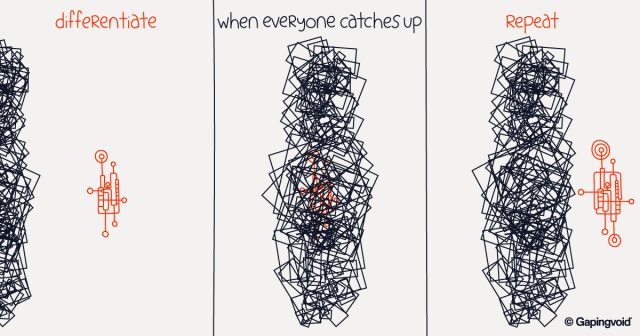
1. "Agents of Calcification". This is a rather snarky term I recently coined to describe the folks in a big company- any big company, not necessarily Microsoft- whose role isn't to invent, make, or sell stuff, but to maintain and enhance the apparatus of bureaucracy, even at the expense of the business itself. Though these agents can serve a legitimate organizational purpose, when any company has too many of these people, you sadly end up with this cartoon [i.e. a "Big Lump o' Death"]. The bigger the company gets, the more energy anybody trying to get anything interesting done will have to spend, trying to navigate around these folk. These folk are why I never take on salaried positions at big companies- I've never been very good at handling them. Despite what Frederick Winslow Taylor may have said, people are not machines. Form NEVER follows function.
2. The Blue Monster came from a simple observation I made early on in my career as a Microsoft watcher: That most people I've met who work there could be making more money elsewhere, and taking a lot less grief from the general public and the media. So what motivates them? The answer to this, in spite of all the baggage that comes with it, is what makes the company so interesting for me.
3. So what happens if the Simon Phipps's of the world are right? So what happens if the future of software is indeed Open Source? How will Microsoft keep its shareholders happy? What if this recent article is right, and the unavoidable future is free software, and paid software is an equally unavoidable thing of the past? What then? Who has the answers? Do the answers actually exist yet? [N.B. I had the distinct pleasure of meeting Simon Phipps this summer at a dinner party, and I found him delightful company. Though his job is working with Open Source at Sun Microsystems, he also had a lot of nice things to say about Microsoft. A true gentleman.]
4. Are people [both inside and outside the company] ready to start seeing Microsoft not primarily as a software company, but as a media company? And if Microsoft's business model turns away from paid software, towards advertising and free software, who will be the winners? Who will be the losers?
5. Calling Microsoft "Evil" is too easy. An adjective used by the incurious and intellectually lazy.
6. I find it re-assuring that most Microsofties I meet don't seem too phased by the fact that I use a MacBook, not a PC. As Bill Gates said recently, "We like Apple, they buy a lot of software from us."
7. A few weeks ago, I was having lunch with somebody very high up the global Digital Advertising foodchain. He was telling me about how once he was pitching for a ten million dollar account with a large international client. The client basically said, "I love the idea. Let's do it. But... can you scale it to a hundred million dollar spend?" My friend sadly had to confess that his idea did not scale that large. My takeaway: Advertising clients are lining up to give talented folk their money. The only problem is, this brave new world is still in its infancy, much the same way TV advertising was in its infancy fifty years ago. Unlike traditional advertising media, demand for services exceeds supply. There lies the opportunity, but even the smartest minds in the business are still having a hard time figuring it out.
8. Though Google may be a fierce competitor of my friends in Redmond, in many ways what they're doing actually makes Microsoft's job a whole lot easier. Google broke a lot of ice when it came to creating a viable mass market for advertisers [understatement]. Thanks to Google, people ARE willing to spend money on online advertising in a way they simply weren't before AdSense came along. If Microsoft [or any other company] can add something to the party, with ever more increasingly sophisticated offerings, they stand to gain on a massive scale. The clients are there, ready and willing to spend the big money. But now the onus is on Microsoft et al to provide a good enough reason.
9. As wonderful and interesting as "Web 2.0" has been to both me and a lot of my friends, the fact is, again, it's still early days. Again, even the smartest people I know in this space have little idea about what's going to happen next. Again, like TV advertising in the 1950s, we're basically making it up as we go along. But that's what makes it so exciting.
10. I still happily stand by what I said about Microsoft, late last year:
For too long, Microsoft has allowed other people- the media, the competition and their detractors, especially- to tell their story on their behalf, instead of doing a better job of it themselves.Let me put it another way: The future of Microsoft, and how Microsoft talks to people in the future, are one and the same. Yes, Virginia, the future of Microsoft is "Conversation."We firmly believe that Microsoft must start articulating their story better- what they do, why they do it, and why it matters- if they're to remain happy and prosperous long-term.

[N.B. in the UK, "pants" means "underpants", as opposed to "trousers".]
This is the best piece of marketing I've seen for a while. Thanks to Eaon Pritchard for sharing.
What makes it so utterly disarming is its simplicity, whimsy and humanity. Nothing more. It's not particularly "clever", which is exactly what makes it so brilliant.
And in case you were wondering, yes, it is indeed a Social Object.
Jyri Engestrom, the anthropologist behind the "Social Object" theory, writes about the Blue Monster. Rock on.
Since its inception by cartoonist Hugh MacLeod, the cartoon has been adopted by microsofties as a symbol of the company's and its people's aspiration to innovate. I've heard Microsoft employees refer to it as the company's unofficial mascot.[Bonus Link: Adriana has a really good post on Stormhoek Blue Monster. Very thoughtful, as usual, coming from her.]
My understanding is, some pockets at Microsoft COMPLETELY get the Blue Monster, and others don't. I suppose that's to be expected with a company of that size.
That being said, from what I can glean from my limited, outsider perspective, there seems to be a large constituency within the company which strongly believes that Microsoft's entire future rests on how well it talks to people outside the company. I happen to concur. "Porous Membrane", Baby!
![]()
[Yon standard pack shot. Indeed.]
I mentioned previously that I would be announcing my "Next Big Project" sometime today, the 17th of September.The Financial Times beat me to it.. "Social Object", Baby:
Microsoft launches a tipple for techiesTonight, a select group will gather in a bar in London’s Soho to quaff a crisp, South African white wine bottled in their honour.
The hand-picked guests toasting the new vintage are not, however, wine connoisseurs but techies. The gathering marks the launch of the Blue Monster Reserve label, created by winery Stormhoek for Microsoft and its employees.
Own-label wine and personalised bottles have become increasingly popular in the corporate world, particularly among investment banks, as gifts to clients and offered to guests of corporate events. The companies hope the corporate vintages will add an air of class and sophistication to their image.
But unlike customised wine bottles given by banks and law firms to clients, this label did not originate in Microsoft’s corporate communications headquarters.
Hugh MacLeod, a cartoonist, blogger and marketing strategist for Stormhoek, created the Blue Monster image after getting to know Microsoft employees.
Mr MacLeod met these “Microsofties” through his day job. “We sponsored a series of ‘geek dinners’ for bloggers and techies in the US and the UK,” he said. “I met a lot of people from Microsoft through these dinners, and they all said the same thing: we want to change the world.”
That notion of a kinder, gentler Microsoft is at odds with its cut-throat corporate image. Critics have accused the software giant of abusing its dominant position and of stifling innovation in the industry. In 2003, the European Commission found Microsoft guilty of uncompetitive practices and levied a record €497m ($689m, £342m) fine. The result of its appeal against that decision is due on Monday.
The cartoon of a sharp-toothed blue creature and its tagline, “Microsoft – change the world or go home”, has now been adopted by some Microsoft employees and fans as a symbol of the company’s innovation.“People see Microsoft as a big, bad corporate monster,” Mr MacLeod said. “Yet all the Microsofties I’ve spoken to say they just want to make great products and do good works. It was obvious that Microsoft had to get better at telling their story.”
“Wine is a social object, and so is the Blue Monster: they both inspire conversation,” he said. “And we thought the cartoon would look really cool on a bottle.”
Steve Clayton, chief technology officer at one of Microsoft’s UK affiliates and a nine-year veteran of the company, said Blue Monster reminded people that Microsoft “has a sense of fun and humour”.
Mr Clayton has been at the forefront of the Blue Monster movement: he uses the image on his business card and is the administrator of a “Friends of Blue Monster” Facebook group.
“[Microsoft’s HQ] has been very supportive of us using the Microsoft name alongside the Blue Monster image,” Mr MacLeod said. It makes sense; they’ve been around for about 30 years and are trying to reinvent themselves to embrace a new generation.”
Blue Monster-branded bottles will be available only to Microsoft and its affiliates. “We have no intention of selling the product outside Microsoft,” said Jason Korman, Stormhoek’s chief executive. “The wine itself only went live last week, and already we’ve had massive interest from different parts of the company.”
Mr Clayton readily admits the Blue Monster movement, despite his involvement, is outside any influence from Microsoft: “[The cartoon] has encouraged a whole new series of conversations by people who are passionate about Microsoft, both internally and externally. Blue Monster is a community which has developed its own distinct identity.”[Blue Monster backstory here.] [Blue Monster blog archive here.]For Mr MacLeod, the Blue Monster represents a revolution of sorts. “We started an underground movement within Microsoft, and we knew one day the guys in suits would finally take notice. That moment has finally arrived.”
If so, it will be marked in true internet-era style: not with an act of anarchy but a clink of glasses.
The wine is not a commercially available product, just a wee "social object" for geek dinners and people inside the Microsoft ecosystem. Microsoft's Steve Clayton and I are still working on the final details of how we're going to get the wine to people who want it, but for now, we're just limiting its availability to [1] people who belong to the "Friends of Blue Monster" Facebook group, and [2] geek dinners we're attending and/or sponsoring.
Personally, I like this idea because it directly connects to a lot of different things I'm interested in. "Social Objects", Microsoft, cartoons, Stormhoek, Marketing 2.0, corporate-reinvention, geek dinners etc etc.
Hopefully, other people will like it, too. Watch this space etc.
A special thanks to all the groovy cats inside Microsoft who lent their support to this project. Rock on.
[P.S. If anyone has any further questions, I can be reached by e-mail.]
The gapingvoid Facebook cartoon app now has over 1100 users. And for people who don't use Facebook, there's the gapingvoid widget, which fits snugly inside your blog sidebar. Both publish the same cartoon simultaneously etc. Different cartoons uploaded pretty much daily etc etc.
[Bonus Link:] "Friends of Blue Monster" Facebook group is now up to 688 members.
I've been getting a lot of licensing queries recently. I thought maybe I should publish my general terms one more time. From April, 2006:
[Add the gapingvoid widget to your blog]
Like I've said many times before, I much prefer giving away my cartoons for free, rather than trying to sell them. It saves everybody a lot of hassle, myself included.
Which is why I'm now letting people download my stuff in high-resolution, print it out and stick it on their wall etc. Which is why I have a Creative Commons license.

Hey, if you want to put the work up on your website, blog, or stick it on paper, t-shirts, business cards, stickers, homemade greeting cards, Powerpoint slides, or whatever, as far as I'm concerned, as long as it's just for your own personal use, as long as you're not trying to make money off it directly, and you're giving me due attribution, I'm totally cool with the idea.
[NB: If you see a gapingvoid cartoon that you like, and you fancy it as a piece of schwag, all you have to do is download the high-resolution image off this site, then upload it here onto Cafepress. I make no money at this, everything on Cafepress I sell at cost. Easy.]
So, if people aren't paying me for my work, then how do I make a living? Good question.
Well, years of messing around in various enterprises have led me to the following conclusion: People don't buy art. Not really. But they do buy wine.
Which is why I have a commercial interest in the Stormhoek winery. Basically, the more cases that sell, the bigger a car I get to drive. It's that simple.
So to the kind folks who download and use my stuff, I say thank you very much, but if you want to support what I'm doing, please keep your money.
Instead, if you're ever in wine-drinking mode, walking down a supermarket aisle, and you see a bottle of Stormhoek on the shelf, I hope you might consider giving it a try. No worries if you'd rather not, but I'd appreciate it if you did.
The other thing you can do to help the cause is add the gapingvoid widget to your blog, but again, no worries if you'd rather not etc.
I guess this all ties in with my "indirect marketing" schtick, of which I am a huge advocate.
Sounds like a plan?
[NB:] Stormhoek is now available in San Francisco and Silicon Valley at K&L Wine.
[BACKGROUND READING:] The "about gapingvoid" page. Also carries some of my favorite cartoons, and what inspired them etc.
![]()
[photo credit: Steve Woolf.]
I've made a lot of t-shirts in my life. The one for blip.tv is without question one of my all-time favorites.
The shirt had an interesting genesis. I met up with blip.tv's Charles Hope for lunch the last time I was in New York. While we were waiting for the coffee to arrive, I drew him the cartoon, right there at the table. Within a few weeks Charles had taken the design and turned it into a t-shirt. The rest is history etc.
Hmmmm... Maybe I should be doing more of these.....
[Charles blogged both the lunch and the cartoon here.]