“Decommoditification”.
This is a word I’ve been using a lot recently, especially with my clients.
Most of us don’t work for Apple or Aston Martin. For most of us, the products we make are not that unique, rare, or desired. We’re selling commodities.
And selling commodities is hard. If you don't give the customer exactly what she wants, there's twenty people lined up who can. And some of these people are younger, sexier, smarter and cheaper than you.
This is what I call the "Commodity Feedback Loop". Once you get into it, it's hard to get out. Every time you try to sell something, there is an unrelenting pressure to slice up your wafer-thin margins into salami. Not a job for the faint of heart.
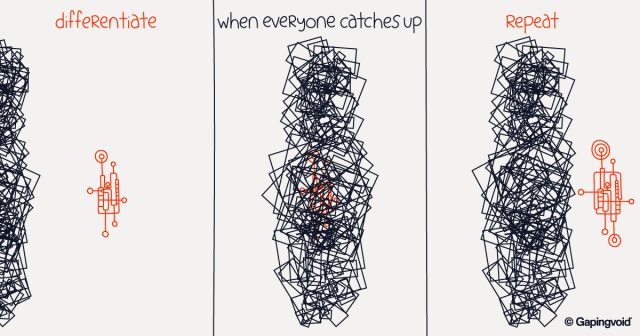
So if this applies to you, then as a marketer, your job is not in the making and selling of something unique, your job as a marketer is making your product seem less of a commodity than it already is. Hence, “Decommoditification”.
And that can be valuable. Look at the Microsoft bloggers. Their company's software is basically a commodity (not unlike the $400 Dell, Sony and Toshiba computers it runs on), but via their blogging they make it seem less so.
I was talking to a Madison Avenue friend the other day. One of his clients is a large retail chain. A commodities business, if ever there was one.
The value his agency provides isn’t selling per se [“Gosh! I think I’ll drop everything I’m doing right now and go shop at the store currently being advertised on the TV!”], but he’s making the store seem less of a commodity than it would be, if he wasn’t doing such a splendid job i.e. bringing passion and authority into the equation.
i.e. He’s not selling products for 10% less than the other guy. What he really is selling, of course, is “Hope”.
And Hope is valuable. Like it says in The Hughtrain, the market for something to believe in is infinite. Rock on.
One could argue that advertising agencies are commodified (sorry, I am used to my contracted terms such as commodification), too: they don’t differentiate, they offer the same services, and many even have the same client roster or claim to have worked for the same clients!
Posted by: Jack Yan at March 16, 2006 12:23 PMSo give people a reason, other than low prices, to buy from you I guess is what you're saying.
You might be more likely to buy an MS product now, than 3 years ago, because you've read some employee blogs, and feel a closer connection to them.
Nice.
Posted by: Adrian Lee at March 16, 2006 1:52 PMPassion? Authority? I think it also takes the intelligence of a genius, courage, and the most devious mind on earth to decommodify anything. Good luck to your friend.
Posted by: Nia at March 16, 2006 2:31 PMCommodification arises out of parity on rational parameters. Decommodification is typically created on non-rational grounds. Net, keep investing in the brand's distinctiveness, and keep creating belief. If you don't, you're dead.
Posted by: Ashish Banerjee at March 16, 2006 7:58 PM"The V-8 Vantage [Aston Martin, duh] is not so much driven as it is worn. No mere fashion accessory, however, it is more like fine outerwear for the bespoke man." -Jerry Garrett, NY Times, 3/5/06
(not sure if this article's been referenced in any gapingvoid comments yet, but talk about taking a car beyond a commodity...)
Brett, Mr Garrett is not too far wrong. I had one for two days last week. Dynamically, it is inferior to the Porsche 911, though the seats are better for my 5'9½" frame. But I would still choose the Aston because æsthetically, it appeals to every bone in my body—and yes, I have to admit I would become a total narcissist and look at me in the car whenever I drove by a big glass façade. After that experience, everything—including the BMW 320i I was loaned for the next five days—seems dull, almost shameful to be in.
Posted by: Jack Yan at March 17, 2006 2:06 AMBadass.
Posted by: Brett at March 17, 2006 6:27 PM