January 30, 2006

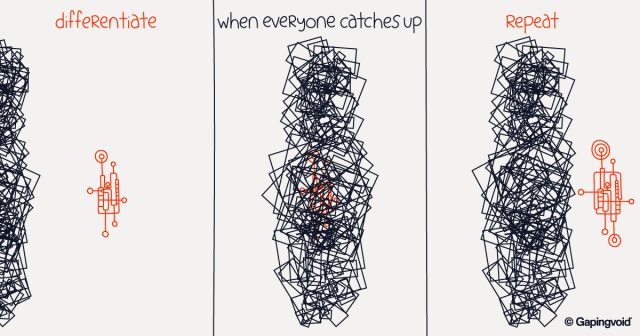
all marketing is disruption. everything else is secondary.

zzzmkghilkj03.jpg
[Haven't posted this cartoon for a while. It's one of my favorites.]

The Artic Monkeys make pop music history by having the fastest-selling British single since The Beatles.

Whatever People Say I Am, That’s What I’m Not reached the top of the charts after recording 363,735 over-the-counter sales during its first week of release. Album downloads from iTunes and other online stores, which have not yet been included in the tally, are likely to push the opening sales past 400,000.
A few months ago I made the comment that the best advertising was not Word-Of-Mouth, as commonly believed, but "Disrupting Markets".

The Artic Monkeys prove the point. They bypassed the music industry entirely, relying instead on the internet, free downloads, playing live gigs and Word-Of-Mouth.

Word-Of-Mouth was not a thing in itself. Word-Of-Mouth was a subset of something much larger going on. The Market. Disrupted. Etcetera.

By changing the rules of the game, people wanted to tell their story. That includes people like me, who have close to zero interest in pop records. Yet here I am, talking about it. Helping to sell their records, even if I don't buy one myself.

Without market disruption, there is no marketing.

Ergo, all marketing is disruption. Everything else is secondary.

[REQUIRED READING:] "Small is the New Big" by Seth Godin. Read it fifteen times if you haven't already.

Posted by hugh macleod at January 30, 2006 11:04 PM | TrackBack
Comments

Hugh

Thanks for posting this, since it fits perfectly with a customer I'm approaching in New Orleans.

There's a recording studio here, one of two left standing in a music business city. I'm telling them that they could syndicate the shavings on the cutting room floor, and draw the attention of musicians, their true customers, and their fans.

Hugh, I've been able to sell myself, by quoting you, and sending people to your blog. You've really created a business model for blogging.

Heh. Maybe I can get a Global Microbrand reseller arrangment. Have you considered a certification program?

Posted by: Alan Gutierrez at January 31, 2006 12:49 AM

Perhaps the numbers would have been even higher were US iTunes users not greeted with: "The item you've requested is not currently available in the US store." when trying to purchase this album. As a American music fan who has often been driven to illegal file-sharing by late or non-release of UK titles here, I look forward to the day when I'll be able to actually *pay* for an album on the day of its UK release!

I've also always felt vaguely insulted by the "Why would you even be interested in something we haven't tried to SELL you yet?" attitude that this policy seems to imply.

I suppose the real bogeyman of internet-driven marketing is that it will make so many location-specific, but functionally redundant jobs (i.e. pluggers, payola-whores) unnecessary.

Posted by: Eric at January 31, 2006 1:14 AM

Nice post as usual, Hugh. But I'm trying to figure out which is more cringe-worthy: "disruptive media/technology/markets" or... "2.0"?

I think the jury is still out, but whenever I hear the terms being used, red flags go up... and there's always that unmistakable stench of hucksterism (by any other name).

Posted by: Bradley Allen at January 31, 2006 3:20 AM

I know Bradley. "Disruption" is the new "Paradignm Shift"... Heh.

[NOTE TO SELF:] Use fresher buzzwords, more often.

Posted by: hugh macleod at January 31, 2006 4:01 AM

Hmmm, I don't know if this is anything beyond a good product and word-of-mouth.

The band aren't/weren't internet savvy. They didn't post their music online.

All they did was distribute freebie CD's at their gigs, and the fans did the rest.

So, that to me sounds like word-of-mouth. People liked the product, people told other people about said good product. Market disruption?

They then released a very limited edition single, before signing to a record company I believe, which sold out on pre-order, and could've sold many more times what were actually produced.

With record companies falling at their feet, they were in the novel position of being able to dictate terms of contracts presumably, and the hype was already starting in the music press.

Then with bigger record copany backing the next single is produced in proper quantities and goes to number 1, and is a big hit with everyone. But it was started by their fans sharing music from some freebies....

Posted by: Adrian Lee at January 31, 2006 12:54 PM

Don't believe the hype! The Arctic Monkeys are not a product of the internet - that is just a savvy bit of music industry PR. I saw the touts selling tickets to their Astoria gig in September at four times face value just like they do to all non-manufactured bands that build a following by live gigs.

Posted by: john at January 31, 2006 1:50 PM

The first-time most people heard of them was later in the year when all the press stories about a band breaking via the internet were floated by the record company. Floated so that the band got mainstream media coverage outside the music press. The internet was created as the hook, it was not the cause of the success.

Posted by: john at January 31, 2006 1:59 PM

Most people may only have started hearing of them once all the major media hype started, but that doesn't disclude the fact that there was something going on before that.

Before they were signed to Domino they were in music publications like NME saying how their gigs were sold out because so many people had found out about them through the shared files online.

The record company may have fed off that, but they did not start it.

MANY people (maybe not most, but a lot more than normal, that's for sure) heard about them before they were signed to a record company (myself for instance) and before all the hype in the mainstream media.

People were going along to gigs in much larger numbers than normal BEFORE the hype in the music press, let alont the mainstream media.

I'm sure they wouldn't have sold 360k albums in the first week without all the mainstream hype, but there is more to it than just that.

Posted by: Adrian Lee at January 31, 2006 2:56 PM

They write great songs. It's the one ingredient people don't talk enough about when dissecting what gets word of mouth, what goes viral, etc. Start with a great product.

Posted by: Jud Branam at January 31, 2006 6:19 PM

Their demos were played on Radio 1 in March 2005 so we can argue till the indy cows come home about what came first. I am entirely in agreement with Jud - the most important P of the archaic 4 Ps of marketing has always been the product.

Many bands before and in the file-sharing era have handed out freebies- the good ones got passed around and copied, the bad ones were binned. The Artic Monkeys are not part of the long tail and therefore I would argue would have come to the fore in non-internet days and that surely is the test of whether the market has been actually disrupted.

Posted by: john at January 31, 2006 8:46 PM

John, I think you're missing the point. This isn't about the internet.

Posted by: hugh macleod at February 1, 2006 6:22 AM

March 2005 sounds about right for when I heard them on Radio1, but that was without the hype. I heard the song, liked it, went online to try and find out more. It seems a fair few people had already heard them, been to gigs if they could, and were sharing mp3's.

A few months later NME are suddenly posting articles about how they've been having packed out gigs due to people finding out about the music from people online. Then the hype started.

My only arguement here is that they are not a product of hype. It's just contributed to it.

I don't know if just having a good product counts as market disruption. 10 years ago they could've been Oasis or something perhaps, without the Internet they would probably have still made it, as Oasis did, because the product is good (as far as a lot of peple are concerned anyway, music is a wonderfully subjective topic), but it wouldn't have happened as fast without the ridiculously easy means of distribution some web sites provide now (MySpaces for example).

Perhaps you could argue it's the web sites used to distribute the music (such as MySpaces) that are disrupting markets, rather than the Artic Monkeys themselves.
Artic Monkeys are just producing music, the same as other bands have been doing for quite a long time. The differences are the tools enabling fans to more quickly share it.

Posted by: Adrian Lee at February 1, 2006 12:14 PM

here is some word of mouth marketing for you hugh

http://avc.blogs.com/a_vc/2006/02/so_great.html

Posted by: fred at February 2, 2006 12:33 PM