Sig asks the pertinent question: What level of transparency can a company live with?
Fact #1:Transparency's a tricky one. Transparency relies on human beings, and human beings are generally a frickin' nightmare.Trust is what makes a company exist. Without trust no customer, no investors, no suppliers, no place in society.
Fact #2:
Transparency equals trust. That simple.
Secondly, "Transparency" is currently one of those terms greatly in danger of becoming an annoying buzzword, if it hasn't already.
But forget the hardcore mechanics of running a company for a minute. Let me ask you another question instead:
At the company you work for, how afraid is the average person of making a mistake? Of not being right? Of backing the wrong horse and being found out later?
And then there's your answer. The less afraid he or she is, the more transparent your company can be, with itself and with the outside world. The more afraid he or she is, the more opaque you'll have to remain.
I don't think it's rocket science.
Posted by hugh macleod at May 5, 2005 2:01 PM | TrackBackThe rocket science comes when you try to make people less afraid...
Posted by: Misja at May 5, 2005 3:13 PMYess, forgot this:
Fact #3:
Transparency requires courage.
And courage requires self confidence. That's pehaps why one says "courage is not a corporate word".
Time to make it a corporate word...
It will only ever be transparent when the people inside (i.e. the ones making you afraid) are comfortable with being seen - you work out what the chances are where you work; where I work hell will freeze over first.
The fear and loathing brigade forgets that it is only those doing nothing that don't make mistakes ...
Posted by: Ric at May 5, 2005 3:34 PMHey Sig - good morning! (It's just gone midnight here ...)
Courage? or integrity? (I know - both would help ...)
Posted by: Ric at May 5, 2005 3:36 PMHugh-- what are your thoughts on transparency when it comes to profits or future business dealings. For instance-- recently, I was in touch with a big humor magazine about doing some columns articles for them, and I didn't name them in my blog-- I thought about transparency for a moment, but I have a lot of other people who seem to read my blog to look for jobs themselves and might swoop in or beat me to an angle I'm working.
Also, on profits-- Should I be open and say how much I've sold of something. I mean, if I'm writing and thinking about these things should i just be honest and post-- for instance, my one print book had lackluster performance. Maybe I SHOULD have told what it sold-- but some things are just embarrasing. So-- I guess you should let them see you fail as well as accompish things.
Thats going to be the REAL challenge for people writing blogs. Just HOW open can they be? Because anything else just smells like a line of bullshit. Know what I mean?
Posted by: DJ Coffman at May 5, 2005 4:06 PMHmmmm, I'm wondering ...
If a company increases it's transparency, does it also find the need for a larger public relations department or a smaller one?
Posted by: Bruce DeBoer at May 5, 2005 5:16 PMRe: Bruce's comment / question above .. I would think smaller, unless the organization wants to spin and work its *transparency* ...
... and arguably, its employees and the way(s) the company interacts with customers becomes a part of its ongoing *PR*.
Posted by: Jon Husband at May 5, 2005 6:04 PMThe transparency can also inspire confidence if it provides valuable information that leads to smarter decisions.
Often, the fear of screwing up comes from having to make a choice based on incomplete info or incorrect assumptions about company direction or customer needs. Then you've got no back-up when some higher-up asks, "Why did we do this?"
Meat puppets hoarde information for just that reason: so others don't come up with a great ideas w/out their input. Talk about shooting yourself in the foot...
Posted by: Timbo at May 5, 2005 6:24 PMEliot Spitzer on line 1!
Posted by: Jim Wilde at May 5, 2005 9:29 PMEliot Spitzer presumably calls to the CEO, and what happens *down below* most often reflects the culture and practices determined or prescribed bythe CEO, no ?
Kinda like Lynndie England taking the fall for Abu Ghraib, instead of the generals or Rumsfeld ?
Posted by: Jon Husband at May 5, 2005 10:29 PMHi Hugh,
In a very general sense transparency is good, and of course we need more of it in order to connect with other people, whether as customers or whatever.
But .... too much transparency can sometimes be a bad thing on both sides of any relationship. Sometimes people want certainty or just not more hassle - this just seems to be common sense.
Transparency as in being honest and open is good. Transparency as in "hey, this is the story of our funky day bringing you your product" can be like an American therapy victim, if you known what I mean - too much information, too little intuition. Do I want great wine, service, etc. from a restaurant? Yes. Do I want to read on their real time internal blog that my waiter nearly threw my soup over the head of the chef? No thanks.
Also, you might to think about your interest in the idea of the SIV (or, more amusingly, SPIV as it was momentarily called ;-) What do stories need? Heroism, redemption, narrative structure, themes, lost love, etc. Stories, like marketing BS, are interpretations of reality for a purpose, which means they are selective. As in not-100%-transparent all the time.
I have gigabytes of 100% transparent stories of the life of our servers at work (Hell - they even TXT me several times a day), but we call them "logs".
I only say this because I often hear people talk about transparency without recognising their own and other peoples' tendencies to conceal, or re-interpret, or re-frame information as a natural part of their communication.
Not you and me, of course, 'cos we're nice. Naturlich. But you know what I mean, I suppose ;-)
Posted by: Lee Bryant at May 5, 2005 11:15 PMGreat points, Lee.
I think everyone gets all juiced about *transparency* because it's essentially a new set of conditions (or at least this degree and volume of transparency seem to be completely new for us) compared to the hundreds or thousands of years of controlling knowledge (the "knowledge is power" thing) that has come before. The structures that have come before have enabled much the "knowledge is power" dynamic. Our behaviours have been affected at the near-DNA level, psychologically and socially, by the various forms of hierarchical (or parent-child, or whatever else we want to call it) types of oprganizational and community interactions we have all grown up in as we become / became adult humans.
As has been said before, hierarchy in and of itself is not evil .. and there are places and times to be more and/or less opne, or transparent. as we probably all know, there is a thing such as "too much information", and many things we wish others would keep to themselves.
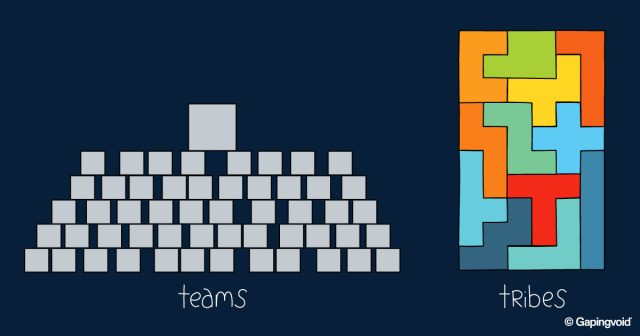
But it will be very interesting to watch how people continue to adapt to, learn new ways of being and doing, and create new social architecture in these new conditions. personally, i don't think it's going to be as simple as all teams, all the time, or just loosely confederated groups of humans (which tend to fall apart at the merest of obstacles unless there are effective leaders and a purpose to the activity).
While it may not be rocket science, it may well be some form of complexity/chaos theory meets the need to get things done whilst not killing others or yourself. And it may be more difficult than we think, given how random and variable each of us humans are .. there's probably a reason why there are so very many psychologists, therapists, coaches, consultants and various forms of self-improvement and self-help resources that seem to stay in business.
A core premise to which i continue to cling is that the reason the leadership and mangement development industries are so large and lucrative is that people don't actually want to come to terms with these new and continuing-to-grow-and-spread conditions of interlinkedness, increased visibility of their actions and of what they and others know, say and do.
Often, they want more prescriptive and formualic "do-this-and-it'll be-allright" answers given to them .. at least the evidence suggests that there is a sizeable market for that.
Posted by: Jon Husband at May 6, 2005 2:05 AMI agree with both Lee and Jon...
Posted by: hugh macleod at May 6, 2005 4:14 AM