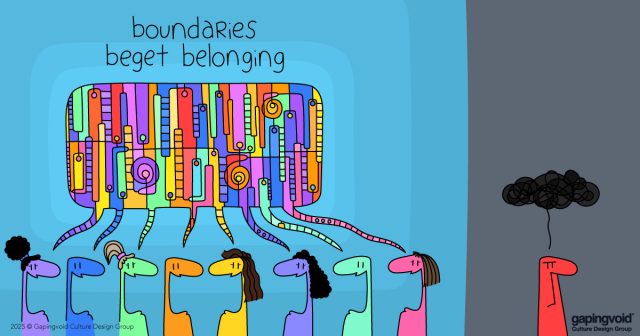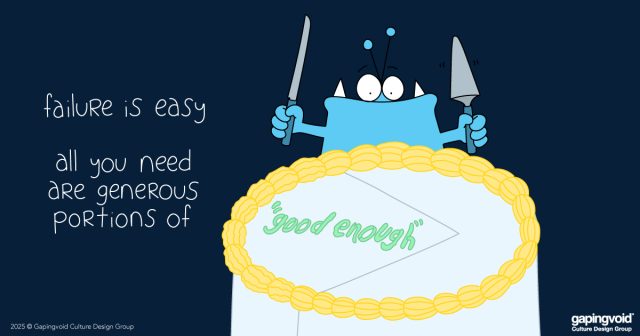
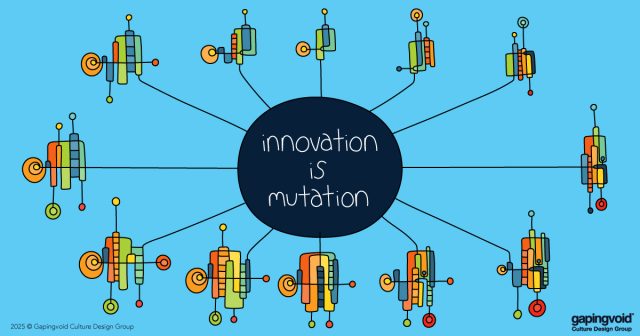
Yes, those were my graphics at Kim Polese's Spikesource presentation yesterday...
My take on Open Source?
Metaphorically, imagine your market was a human body. Now imagine a human body that doesn't need vital organs in order to survive.
If you can imagine that, then that begs the question:
"Why pay a corporation for an expensive pair of lungs, when you can millions of microlungs for free?"
Indeed.
[DISCLAIMER:] I am not an authority on Open Source. I am just a cartoonist who was asked to draw some cartoons, by some people who are.
Posted by hugh macleod at April 7, 2005 1:27 AM | TrackBackPerhaps this is more like a human body that can outsource certain non mission-critical functions - like the digestive tract using third-party bacteria. Some functions may be so critical that a dedicated system is required ... the heart is pretty closed-souce.
Interestingly, some of the really nasty diseases suffered by humans, like Cancer and HIV occur when something malicious gets into the "source code" of our body and starts mucking around ...
The myth of Open Source is that it is anti-corporate, but if you look at where the money has come from for all this development, it is of course funded by Big Corps ... most of the big players have dedicated staff on the big OS teams. IBM jumping onto Linux provided a much needed boost into the mainstream, but was a very careful strategic ploy ... simultaneously breaking open the Big Iron Unix market and severely threatening Microsoft on the desktop.
If you can't beat them at their game, just change the game and ignore theirs altogether. Hey, Hugh, isn't that what you're doing?
I'll shut up now.
Posted by: Toby Hede at April 7, 2005 8:03 AMMaybe that's what [Open Source|Free Software] (delete as appropriate) *was* about; a collection of hobbyists writing small programs, but it's certainly not anymore. I'm involved in the Debian GNU/Linux and GNOME Desktop Environment projects and they are some of the biggest projects, and similarly not funded by any "big corp". Now corporations can fund their own "derivatives" of these products; such as Novel producing SuSE Linux distrobitions with the GNOME Desktop Manager.
I also couldn't disagree more with the previous comment. His complete lack of understanding of what Open Source / Free software actually is is pretty outstanding. Also his broken metaphors of something "getting into the source code" is ludicrous!! As any Microsoft Windows user knows; you don't need the source code to suffer from viruses. Open source software is peer reviewed by very highly skilled programmers, and are managed such that broken or dysfunctional code can't be introduced.
Open Source has nothing to do with being anti-corporation. Indeed IBM, Sun and many large corporations release software under open source licenses. Open Source software is software that is released *as source code or with its source code* with a licence that respects the freedom of the reader of that source code. Put simply; you release a bit of software with its source under the GNU Public license (or similar), then people are able to take your software source and tailor it to suit themselves. Should they produce derivative works, they must release those works under the same license as the original work.
I have never been more impressed by the level of work coming from the open source comminity, and it's been not only of the scale of "commercial products", but pretty much always of vastly higher quality. Think; Apache HTTP server, the Linux Kernel, ext3 filesystems etc etc etc.
You can boil open source / free software down to one point; *freedom*.
Posted by: Ben at April 7, 2005 11:16 AMI'm not saying it's anti-corporate, I'm suggesting that it undermines the privately owned, privately controled vital link in the chain...
[DISCLAIMER:] I am not an authority on Open Source. I am just a cartoonist who was asked to draw some cartoons, by some people who are.
Posted by: hugh macleod at April 7, 2005 12:22 PMThe main gist of my comment was to answer Toby Hede's original point.
That said; I hope I have gone some way to clarify what open source is about. It's been subjected to perjorative campaigns from companies such as Microsoft, but it's in essence the way programmers have always done things.
Think about when you were a kid (if you were anything like me). You got a toy for Christmas, and played with it constantly. When it got a bit boring, you'd "find out how it worked" by pulling it to bits. Of course, all you'd have left afterwards is a collection of random broken bits, and not much more of a clue - but it's the start of something.
Open source is the right to open up your toy, and (if you have the skill) use the constituent parts for other things, or fix bits of the toy yourself. If it breaks, you can fix it (or there is someone that has worked out how to fix it can tell you how). "Closed source" is the reverse. It's a "black box" that can't be opened; legally or relatively practically. Closed source means that you have to wait for the original company that hold the "holy grail" to consider your request and fix whatever bork you report.
But it's more than that. Consider how you learn to write English. You study other - much better - authors, and create your own derivative works. This process is covered in Lawrence Lessig's book; Free Culture. Programmers do exactly the same. You start by "copying" others work, and finally start to understand. The old koan is to; "follow the master, become the master".
The point of open source is to see, and be able to use the source code. Most people will think; "I'm not a programmer, so why should I care? Well, people that *are* programmers will have more than likely already come up against problems with the code, and fixed them. By the time you /would have/ found a problem, it's no longer a problem.
It's about everyone's right to freedom that should be protected at all costs. You've only got to look at the group of people that are going on about it: programmers. Programmers are arguably perfectly poised to understand the ramifications of closed source, non-free licensing and software patents, so if they all are making the same point; there must be something in it!
Hope this is of some way helpful...
Cheers,
Ben
Posted by: Ben at April 7, 2005 1:15 PMThe simple reason why IBM employs a couple of Linux hackers, is that that's much cheaper than employing a huge number of AIX hackers.
Linux will stay open source, so IBM has an operating system that's auto-maintaining and auto-evolving, and they only need to pay a small number of employees for that, while they make loads of money on service and consulting contracts based on that software.
Open-source for companies is about sharing development to cut costs: Linux (kernel), Apache, PHP.
Open-source doesn't work for Really Good Software: on my Mac I install software by drag-n-drop. I configure it with a simple GUI. If Apache and Sendmail worked like that, nobody would buy Sendmal consulting. If Java web services were freaking easy to set up (as it should be), then nobody would ever need to pay for service. So really easy-to-use software that's also open-source potentially destroys business.
Of course that's just competition; it's hard for a small company to deliver a better product than a whole army of volunteers. See Opera vs. Firefox (okay, that Browser would have gotten nowhere without extensive funding by the Mozilla Foundation, but still...).
"Begs the question" means the opposite of what you think it means.
Posted by: Steve Huntley at April 7, 2005 4:47 PMUlrich,
The problem is that sendmail is inherently complicated, wheras iChat or iPhoto is pretty simple. Lots of servers don't run a nice GUI either, so it would be pretty moot.
You're right that IBM can earn a load of money in service contracts, but you're wrong that it's detrimental to small companies. Small companies can now put together an industry class solution using open source products - not costing them big bucks which would have kept them out of the market in a "corporate" world. As a small business, you can take open source products and write the "glue" that holds them together fairly easily - thereby getting paid for what matters; your experience and skill in the industry, rather than the fact you screw companies for cash through heavy licensing fees.
Similarly, as you posit; if sendmail / apache was "really good software" you'd never need specialists to help you. Unfortunately, as products get more and more complex - even if they're exceptional products - you're going to need someone to help you. It's not a failing in the software that it's complicated. After all, who has the time to learn everything? Why should an advertising executive have to configure his own mail relay? Just because cars have become more and more stable and effective over the years still doesn't obviate the need for mechanics or garages - maybe just more skilled mechanics and more effective garages...
The software world is changing - gone are the days you write a "tool" then sell that tool to customers. Now, pretty much every tool that someone wants to use can be obtained for free. The software industry is no longer a shrink-wrap enterprise.
Having said that 99.9% of all points raised have little to do with what us (the writers of this software, and the choosers of the licenses the software is released under) mean. It's not done to raise money for IBM, or to beat Microsoft (directly). It's done because we understand that people - all people - have *the right* to use software without restrictive licenses or terms and conditions. These people wrote apache (which I suspect powers gapingvoid.com as Launch Site hosting use Linux machines) and "gave it to the people". It just so happens that a lot of these "free" (as in freedom & free beer) products happen to be exceptionally good software.
We're fighting for everyone!
Posted by: Ben at April 8, 2005 4:36 PMIn fact - I've just portscanned gapingvoid.com and it does indeed run Apache :-)
Posted by: Ben at April 8, 2005 4:47 PM