The t-shirt thing is coming together nicely. Planning on launching circa first week in April.
Talking to my manufacturer- a very smart fellow- about business issues in general.
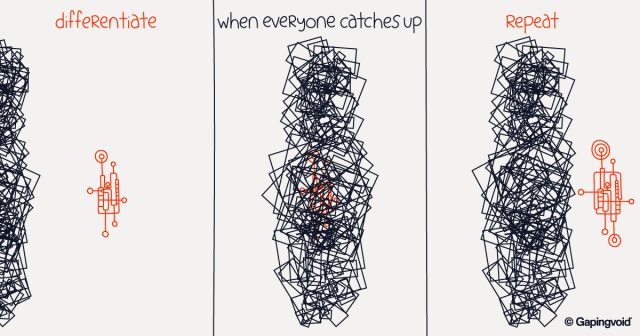
We both concur that the biggest problem in the Western world is oversupply.
For every mid-level managing job opening up, there's scores of people willing and able. For every company needing to hire an ad agency or design firm, there's dozens out there, willing and able. For every person wanting to buy a new car, there's tons of car makers and dealers out there. I could go on and on.
I could also go on about how many good people I know are caught in oversupplied markets, and how every day they wake up, feeling chilled to the bone with dread and unease. Advertising and media folk are classic examples.
So maybe the thing is to is get into "The Tao of Undersupply".
If only 100 people want to buy your widgets, then just make 90 widgets. If only 1000, make 900. If only 10 million, make 9 million. It isn't rocket science, but it takes discipline.
It also requires you to stop making the same stuff as other people. Doing that requires originality and invention.
Like it said in "How To Be Creative", don't try to stand out from the crowd, avoid crowds altogether. Again, it isn't rocket science.
That why all the t-shirts will be limited edition. Actually, I think everything I make from now on will be limited edition in one way or another.
What about your stuff?
Posted by hugh macleod at March 17, 2005 12:18 PM | TrackBackSome 25 years back I went into the publishing business - with almost zero initial capital. So what to do? Instead of having tons of books printed which would only have blown up our inventory, we offered subscriptions to limited editions. When orders were in and the publication deadline was due, we only had to produce so and so many copies (just slightly more than subscribed to service fresh orders).
This not only saved us tons of capital, it was actually a whole lot more lucrative, too: no interest on inventory, lower administrative overhead, etc. We actually made a lot more profit that way because of course those limited editions were quite pricey (about 4 times the regular price of books in this particular market). And yes, this was stuff not available anywhere else and quite attractive to our target group.
After a while, we had lots of subscribers who'd blindly order almost anything whenever we announced it - obviously collectors, maybe some people speculating on appreciation of product value due to its scarcity. Plus, perhaps, the greed factor at play to some extent ...
The most interesting part was that this approach actually tends to *create* a market rather than simply servicing one. The slogan "Invent your own market" was very much to the point here.
Posted by: Ralph Tegtmeier at March 17, 2005 4:12 PMYes Ralph, I think we're both reading from the same page.
And that's a very good point- a customer base motivated primarily by greed certainly shifts product faster than just about anything.
Posted by: hugh macleod at March 17, 2005 4:26 PMGood thought Hugh.
Reminds me of recent thoughts about billboards (there’s a giant one just beyond my flat).
While the contest for the right to put advertising on the face of the billboard will heat up and cool off – the work of the billboard remains the same.
Purchasers of the right to advertise in that space compete for bandwidth instead of “more brilliant” or “new innovation”.
Every time that sign changes faces its annual salary goes up. People are competing for its time - its not.
This is also tied to John Jantsch’s idea (at Duct Tape Marketing) that the savvy provider “generates more leads, more opportunities, more clients than they can possibly serve, and then raises their prices.”
John writes: “Here’s the theory – If I have more demands on my time than I can meet. I can look someone squarely in the eye and name my price, because I don’t ‘have’ to get the order. It also allows you to work only with clients you enjoy.”
John calls this singing-like-you-don’t-need-the-money. Seems to me that the convergence of this and the billboard principle means a higher premium for the same amount of work.
Posted by: Jeremy Heigh at March 17, 2005 5:35 PMLove this post ... but I am struggling to apply it to situations where you don't make 'widgets.'
If I am an ad agency, how do I make less of 'brand X' or whatever it is that I offer?
If I am an individual with a certain set of skills and abilities, how do I limit the supply and therefore increase the demand?
Posted by: John Koetsier at March 17, 2005 6:52 PMJohn K, I suppose the answer would be to get enough clients where you have to turn work away on a regular basis.
Posted by: hugh macleod at March 17, 2005 7:06 PMI did something similar with my photographs a few years back. With a small market, I chose an even smaller number of products, limited editions with the minimum run of one of them being just 7. It worked for as long as I was doing it.
But I got bored selling and lost interest in making the images in the first place. I stopped selling and got back my love of taking photographs. I'm 'richer' now!
Your post also put me in mind of Hucklebery Fin, who managed to get Tom Sawyer to finish his work on a fence by creating an irresistably exclusive opportunity.
Posted by: Huw at March 18, 2005 8:01 AMI am here for the first time ever. I did not read the article. I just wanted to tell you that you have one reader more here. See the next comments for what I like especially at gapingvoid!
Posted by: Michael at March 18, 2005 12:17 PMWhat about our company? We are selling environmentally friendly biodegradable packing materials. I don't think we can say to a customer who wants to buy 1 million that we only can produce or deliver only 900.000. If we do that, we are out of business, and we want to stay in.
And - regrettably - we are not big enough to say that we only want 9 (not 10) customers.
Anyway - have a nice weekend, you gapingvoids.
Posted by: Roy at March 18, 2005 12:44 PM