Nov 2, 2026
Stop Trying To Reason With Everyone
Humans are odd creatures.
If we read a bad idea in a book that feels physically heavy and robust, studies show we’re more likely to accept it and value the book’s wisdom.
If we’re talking to new acquaintances at a dinner party, studies show that holding a warm drink in our hands as opposed to a cold one makes us more likely to identify our new pals as socially warm.
And up until recently, combat sports athletes who wore red apparently received a minor but not insignificant advantage in close bouts due to judge bias. Kind of like how red cars supposedly get pulled over more often.
Examples proliferate. And the lesson is clear: We’re not as rational as we think we are. Not as discerning. Not as logical. Not as well-equipped to tell fiction from truth.
Now, some people take the immense evidence of our biases and irrationality as a sign that we can never know the truth. Of course, if we can’t know the truth, we can’t know that we can’t know the truth – and the whole claim implodes.
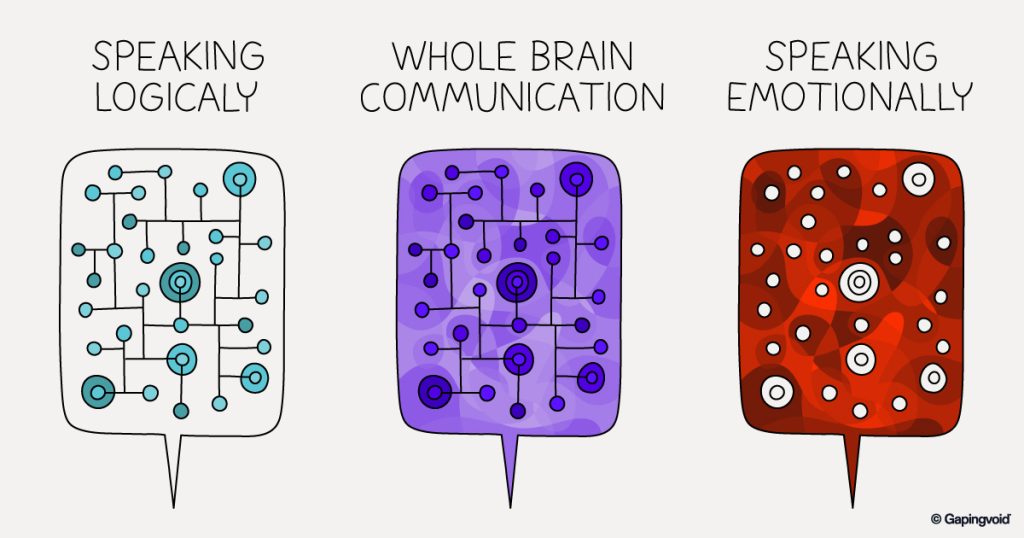
We take a more modest position: Humans have a rational and an irrational mode, and A) there’s no telling which mode someone is in, and B) we are all in the irrational mode a not-insignificant amount of the time.
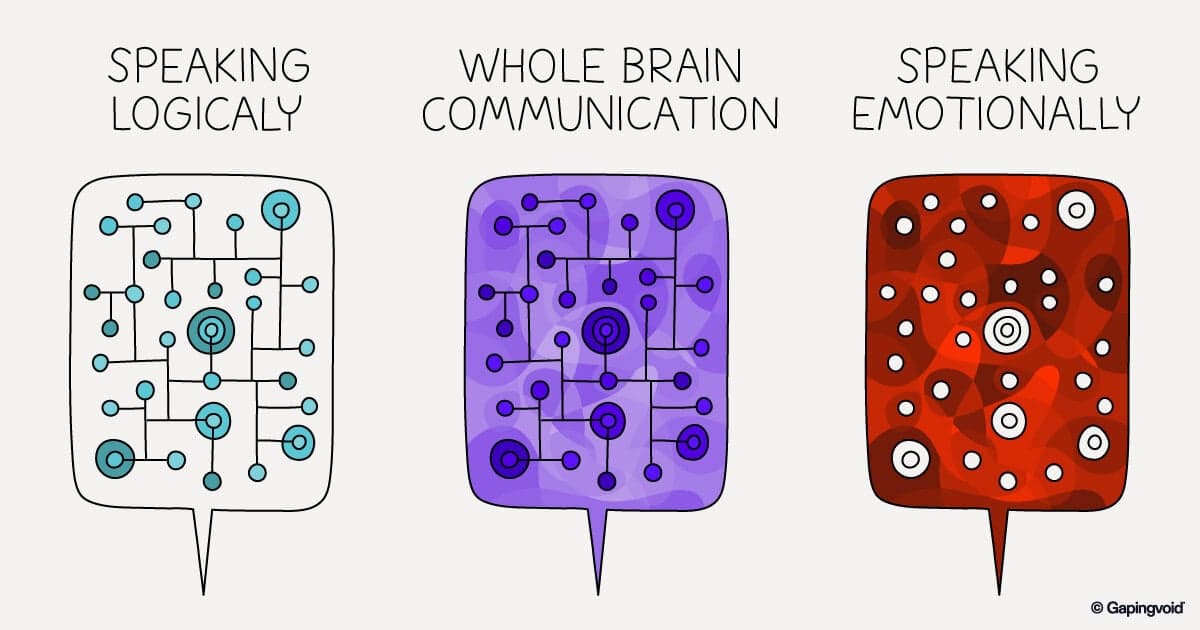
Which means effective leaders speak to both sides of human nature – the side that’s capable of advanced calculus, but also the side that subconsciously favors one competitor because he wore red.
Great leaders have always done this. They’ve thought deeply about the problems they hoped to solve and the best ways to solve them. They’ve done the work. They didn’t take shortcuts.
But when they communicated to the crowds, they didn’t assume that everyone was in the same cool, calm, and calculating headspace. So they told stories. They wove vivid, hard-hitting (or heart-hitting) metaphors. They used bold, audacious, inspiring language.
Communicating purely rationally (or purely emotionally) has a fatal flaw: It ignores 50% of who we all are as humans.
Great leaders speak to people. The logical, rigid side, yes, but also the squishy, fuzzy, emotional one. Anything less than that isn’t quite speaking to ‘whole people’ – it’s speaking to halves of us.
And half-measures never achieved much of anything.