|
Here’s a very simple question. Imagine you are present at a board meeting where a group of people put forward a tightly-costed, well-argued proposal for the design of a new railway station. Everything within the proposal makes perfect economic sense. The throughput of passengers will be efficient, retail rent will be high and there will be an array of ticket barriers to prevent fare evasion.
Now can you imagine raising your hand with the following objection: “I like your proposals on paper, but I can’t help feeling the station you propose is a bit boring.”
Or, more specifically, “Yes, all well and good, but where’s the champagne bar?”
No-one would ever do such a thing. In business, and perhaps more so in government, collective decision-making has become an exercise in the display of pure rationality.
This is a problem. It is a problem because we as humans do not really care about the things that rational people think we should care about.
The reason for this is simple and inevitable. We have not evolved to perceive the world objectively. This is because, for various reasons, our sensory and emotional apparatus has been calibrated to detect and react to things according to their importance to evolutionary fitness, and not their measurable objective qualities. We are, for instance, disproportionately attuned to detect faces in things, even in inanimate objects because, in evolutionary terms, things with faces were usually more important to our survival or reproductive prospects than things without eyes, noses, and mouths.
What this means is that we are ineluctably wired to respond to meaning and significance, rather than to objective metrics. The meaning and significance of something, unlike objective metrics, can be affected not only by changing reality but by changing context – or even by telling new stories about the thing.
Hence it is possible to produce something which in objective terms is a significant improvement and find that people don’t give a damn. And, in the same way, it is possible to make rather trivial changes around a product or experience and find that people’s emotional state is transformed.
A television, as an item of technology, only emits three primary colours. Red, Green, and Blue. Not coincidentally, these are the only three colours to which human (and higher primate) colour vision is sensitised. Televisions do not bother to produce ultra-violet and infra-red light because humans (unlike, respectively, birds and snakes) cannot detect them. And televisions do not bother to produce yellow photons because the impression of yellow can be more efficiently created by simply firing off equal quantities of green and red light.
In the same way, I would argue, when we design something for human experience, we should take the lead from television designers and focus our efforts in the realms of perception to which humans are emotionally attuned, and seek to improve emotional resonance over quantifiable objective properties.
Take that station example above. When St Pancras Station was reopened after a long refurbishment to cater for new high speed and Eurostar trains, the press release (from Freud Communications, I think) contained the rather bizarre detail that the station contained “The Longest Champagne Bar in Europe”). This bizarre fact seemed to resonate with journalists, who all faithfully reported the news.
Now, if you were to ask for a long champagne bar in that board meeting, you would look like a trivial idiot. In collective decision-making, even mentioning subjective factors would expose one to the risk of ridicule.
Any rational person would suggest that “the longest champagne bar in Europe” was a fairly crappy superlative. (A bit like my own claim to fame that “my grandparents were the fourth family in Wales to own a dishwasher”). Generally, people don’t care all that much how long champagne bars are.” No one has ever, I think, asked the question “I feel like going to a champagne bar – can you tell me some nearby places – ordered in declining order of length.”
But to human perception, that sentence was a burst of pure green light. Because in one sentence it conveyed that this station was not a mere utilitarian transit hub – it was a place of entertainment; a destination in its own right.
I call these such things examples of alchemy. Because, in a single phrase, they turn base experiences into gold.
Later, even more money was spent upgrading London Bridge Station. One billion pounds as spent transforming London’s most hated station into what is objectively a pretty good station. Certainly, it is much better than what preceded it. But this time they did not employ an alchemist.
If they had asked me, I would have said “take out two coffee shops and make sure the main concourse contains an enormous florist’s shop – ideally “The Largest Florist in London”. If you lose a little rent attracting a florist rather than a coffee shop, it is a small price to pay for the additional emotional resonance.
Remember most people aren’t architects or specialists in ergonomics. If you ask them “what do you think of the new London Bridge station?” they are unlikely to reply with reference to fine architraves, or the efficient throughput of passengers at peak hours. But they might say “Aren’t the flowers lovely when you come down the escalator!”.
Alchemy isn’t even expensive. And the effect it has on human emotional response is out of all proportion to its cost or difficulty. The reason we don’t practise it more is that the modes of thought in business and government are dominated by economic logic and hence do not allow for any virtue other than efficiency.
But nobody ever liked a station – or a hospital, or a wife or husband – purely because it is efficient. The things we notice and acre about, and which duly affect our emotional state, come from a different place.
Indeed it is one of the virtues of free markets that, by a process of variation and experimentation, they tend to provide us with things we like, rather than things which are logically optimal. I recently spoke to someone who had lived under communism in the Soviet Union. She remarked that the clothes supplied by the regime were often of quite good quality. But what people wanted was jeans.
Economists, consultants, and rationalists are very valuable thinkers. But we will never be maximally happy in a world designed by them alone.
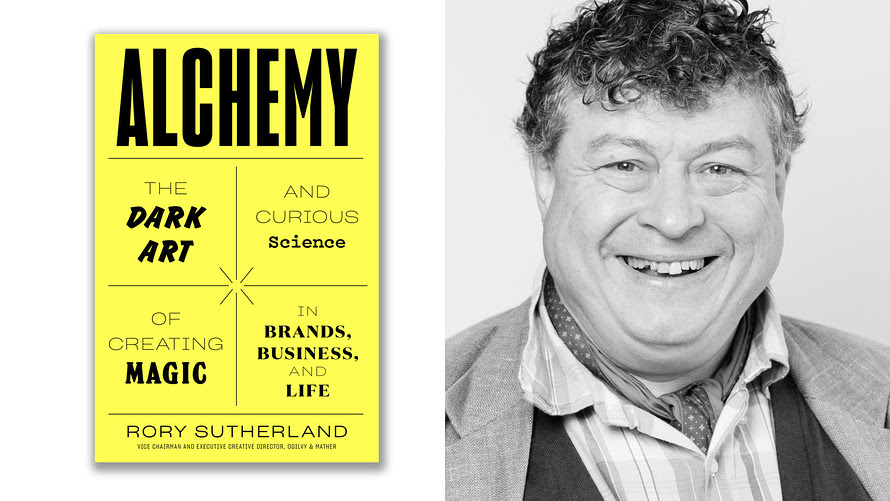
Adapted from Alchemy: The Surprising Power of Ideas that don’t make Sense
by Rory Sutherland
|