You know the old cliché about the moon and the stars?
That if you shoot for the moon and miss, it’s all well and good because you’ll still land among the stars, and that’s pretty neat too?
Right. Well, according to the man who actually brought mankind to the moon, this cliché is exactly correct.
But not for the reason you think.
Everyone knows Kennedy’s famous line: “We choose to go to the Moon in this decade and do the other things, not because they are easy, but because they are hard…”
But most people haven’t heard the line immediately after it:
“…because that goal will serve to organize and measure the best of our energies and skills…”
Kennedy didn’t say the moon would give us new energy. He said it would organize the energy we already had. That’s a massive difference.
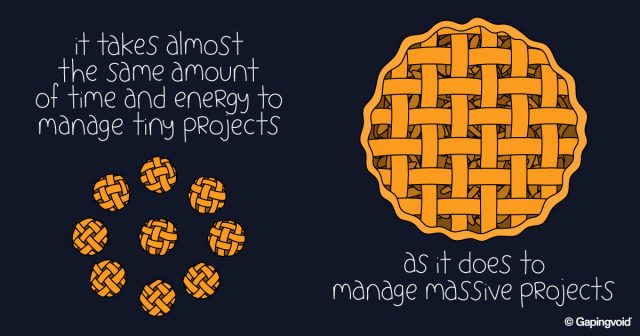
Most leaders think aiming higher costs more. More effort, more risk, more energy than they currently have to spare. It doesn’t. As our friend Dr. Benjamin Hardy points out in The Science of Scaling, setting an extremely audacious goal with an equally audacious timeline doesn’t have to mean more people, more money. MORE everything. It just requires different.
Recently, Canva hit $4 billion in annual recurring revenue. And Canva co-founder and Chief Product Officer, Cameron Adams, said something that caught our eye: “We’re always thinking about disrupting ourselves, and we feel like we’re still only 1 percent of the way there…”
Do the math. That implies a $400 billion target. They probably won’t get there. But like the moonshot, that’s not the point.
Aiming at $8 billion leaves room for incrementalism. Playing it safe. A slow drift towards stale and stagnant that kills a lot more companies than competition ever does.
Aiming at $400 billion on the other hand, demands a completely different operating model. You don’t just do the same thing with more people, faster. You do a different thing altogether. Like rearranging the tiles on your Scrabble rack, it forces you to see words that were always there.
What we aim at shapes what we see. What we see shapes what we do. What we do shapes who we become.
Kennedy understood this. Cameron Adams seems to. And a few days ago, four astronauts lived this.
Reid Wiseman, the Artemis II commander put it this way from 250,000 miles out: every time we take another step forward, the world seems a little smaller and a little more manageable. Not smaller as in diminished. Smaller as in comprehensible. As in, we can do this.
You don’t get ready and then aim high. You aim high, and the aiming makes you ready.
We won’t always go all the way to the moon, perhaps, but we’re pretty damn confident we’ll land among the stars.