Our friend, Rory Sutherland (Vice Chairman of Ogilvy and one of the sharpest thinkers in behavioral economics, shared a great insight with us recently: “You Can’t Perform Magic in Physics. But You Can Perform Magic in Perception.”
It’s a beautiful explanation of why many teams and leaders stay stuck.
Behavioral economics like good old fashioned economics goes back to the father of economics, Adam Smith.
Both are about creating models to describe human behavior.
But classical economics is abstract, built on logic and reason. Behavioral economics is built on psychology. Not what should happen, but what actually happens.
To use a chess metaphor, the economist says, “If I move my supply bishop here, he’ll move his demand rook there.” Whereas the behavioral economist will say, “Chessboard? What chessboard?”
Classical Economics was a product of the 18th Century Enlightenment era, which assumed human beings were rational and logical beings. All we had to do was use logic and reason and solve problems.
Except people aren’t really built that way. We do things for all sorts of reasons. Fear, ego, status envy, insecurity, unresolved childhood drama. Life is messy. People are messier.
Rory put all these thoughts down a couple of years ago in his book, “Alchemy: The Dark Art And Curious Science Of Creating Magic in Brands, Business, and Life”.
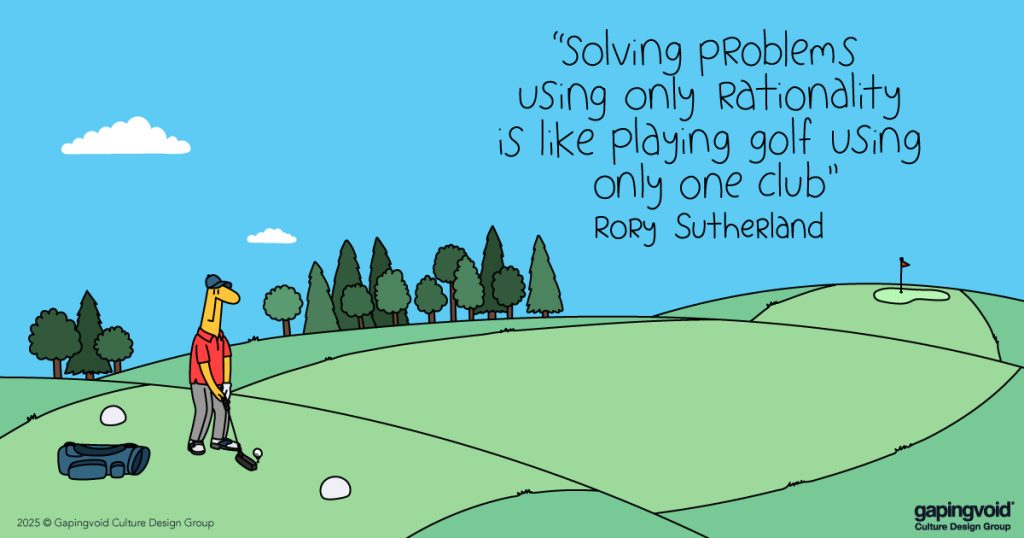
His thesis is yes, logic has its place, but you have to leave room for the illogical. Otherwise you erase all the space where the real magic happens. And you end up with the same answers as your competitors.
Red Bull is a great example. If you wanted to compete with Coca-Cola, logic would tell you to make something that tastes better, costs less, and comes in a bigger bottle. Red Bull did the opposite. It was expensive, came in a tiny can, and tasted terrible in consumer trials. By every rational measure, it should have failed. Instead it became one of the most successful beverages in the world. Because it wasn’t selling a drink. It was selling an identity.
It turns out, life is a lot more messy and irrational than the logical thinkers would like it to be.
His insight is that organizations get stuck on logic and reason because they’re incentivized to do so.
In these systems, if you follow the playbook and fail, you can defend yourself for being logical. If you try something crazy and fail, you’re out of a job. Logic becomes the culturally safer bet. As companies grow, they gravitate toward it, closing doors to alchemy along the way.
And yet, the Good Lord gave us a taste for irrationality, craziness, and a sense of play for a reason. Without them, we’d be incapable of outlier thinking. We’d still be in the Stone Age. A very dull, uninspired Stone Age at that.
You can’t perform magic in physics. The laws don’t bend.
But leave a little room for crazy? That’s where the real leverage is.