There was a delightfully odd moment during a recent Oklahoma State game.
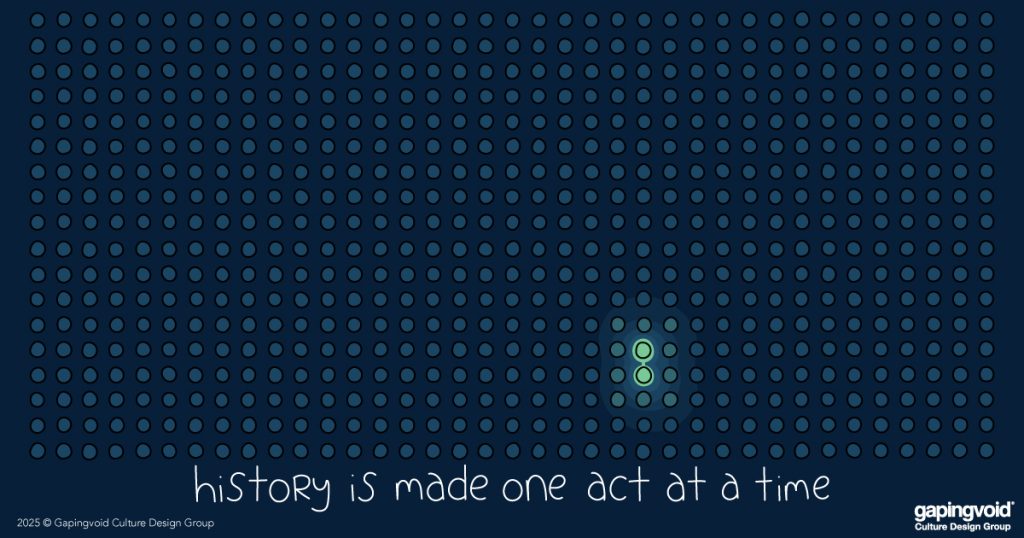
A fan named Trent Eaton made his way to an empty section of the stands and started twirling his shirt in the air. All alone. No announcement. No plan. And within a short time, hundreds of people joined in.
What started as one man’s lone dance, eventually took over multiple sections of the stadium and made the evening news.
It’s what the clever folk call “Behavioral Contagion.”
A neat little trick given to us by evolution. It means we’re hardwired to copy other people, especially what we perceive as successful behavior.
This is why the whole class starts copying the cool kids’ fashion choices in Sixth Grade, or why tech founders start using the same buzzwords as the billionaires they see on YouTube.
Oh, but it goes way deeper than just following trends.
Let’s say you’re feeling good. Or bad. Either way, there’s a decent chance that your mood is just a mirror of the mood of the last person you interacted with.
Talk with a cheery customer service rep on the phone, and you start feeling sunny too.
Get stuck on a project with a grumpy coworker, and you start feeling down as well. A controversial 2012 study by Facebook even found that showing people more negative social media led people to post more negative posts themselves – without even realizing it. (The reverse was also true.)
This Eaton fellow didn’t go around beseeching people to join him on cue. He didn’t hand out flyers or make speeches. He didn’t say anything.
He just did his thing. Boldly. Visibly. Publicly. And it spread.
Behavior change is mostly imitation, not persuasion.
Which is why great leaders constantly leverage this principle. They don’t just articulate a standard of behavior, they embody it.
George Washington crossing the Delaware with his men. Leonidas heading up his small force of Hoplites at Thermopylae. Alexander the Great at the spearhead of his cavalry. Zelensky refusing evacuation from Kyiv. USMC General James Mattis eating last. As the U.S. Marine Corp leadership principles still state, “Set the example.”
Great leaders don’t simply sell their belief systems. They live them. As the t-shirt twirler reminds us, actions are not only one of the most honest forms of communication but often the only one that works.