Frederico Fellini’s 1960 film, “La Dolce Vita” is considered by many to be one of the best pieces of cinema ever made. If you see it, it’s easy to see why. Multi layered, a bit surreal, it has a host of insights buried within it.
It’s a story about a tabloid journalist who dreams of writing something meaningful but finds himself trapped in Rome’s endless party circuit instead. Aristocrats, movie stars, bright lights, the whole glittering mess.
In the end, he finds it all a rather empty and unsatisfying pursuit, yet he somehow lacks the character to leave it behind and go do something more worthwhile. The more we watch Marcello try to find something meaningful in the pursuit of the meaningless, the more sad and painful it is for the audience.
On the surface, it’s a damning indictment of contemporary society, especially the upper classes. But dig a little deeper, and you realize it’s a lot more than that. It’s not just about rich people being decadent, it’s about us. You and me. We’re really no different.
Why? To quote the Swiss author Germaine de Staël,
“One must, in one’s life, make a choice between boredom and suffering.”
The amateur philosopher and retired tech entrepreneur, Martin Butler explains it well in a short YouTube video. To paraphrase:
The human experience is a binary: We’re either striving for something (a form of de Staël’s “suffering”), or we’re bored. Humans hate being bored. Our brains are problem-solving machines, therefore we’re always striving, always looking for new problems to solve. And if we’re not, we’re bored. But we can’t stand being bored, we’re programmed to abhor it. So we fix the problem by either striving for something worthwhile, or we look for something to distract us.
What neither mention is that both options involve suffering.
You can suffer through pursuing something that matters: the uncertainty, the sacrifice, the possibility of failure. Or you can suffer through avoiding it: the quiet knowledge that you’re capable of more, the need for increasingly elaborate distractions.
The New Yorker cartoonist, Saul Steinberg, nailed this idea:
“The life of the creative man is led, directed and controlled by boredom. Avoiding boredom is one of our most important purposes. It is also one of the most difficult, because the amusement always has to be newer and on a higher level. So we are on a kind of spiral. The higher you go, the narrower the circle. As you go ahead the field of choice becomes more meager, in terms of self-entertainment. In the end, working is good because it is the last refuge of the man who wants to be amused. Not everything that amused me in the past amuses me so much any more.”
So this is the position Marcello finds himself in; unable to make the hard choice between striving and boredom means he ends up with a third choice: living in a neither-nor purgatory of chasing distractions. Looks like heaven, feels like hell, but is not really either.
Most of us have found this option in our work. The comfortable middle. Decent work, reasonable hours, work-life balance. It all looks pretty good from the outside, but let’s be real, we wouldn’t do it if we weren’t getting paid. Which begs the question: are we really doing something meaningful, or are we just allowing ourselves to be distracted?
Greatness requires meaningful suffering. Everything else – whether it’s Marcello’s parties or our optimized lives – is just sophisticated ways of choosing the other kind.
Look around you. How many people are building something they believe in versus how many are choosing comfort? The comfortable middle is still a choice. It’s the choice to suffer quietly from unrealized potential rather than suffer loudly or visibly from pursuing it.
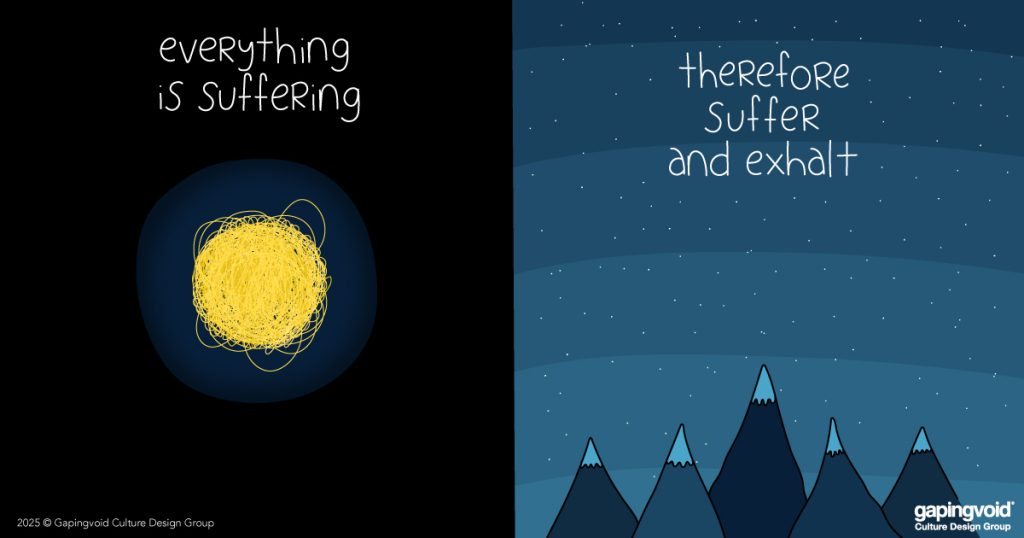
Notice how de Stael uses the term “suffering,” and Butler used the term “striving?” This is perfectly apt – because striving is really what life is about, and as the Buddha said, life is suffering.
Just remember, suffering is mandatory. Greatness is optional.