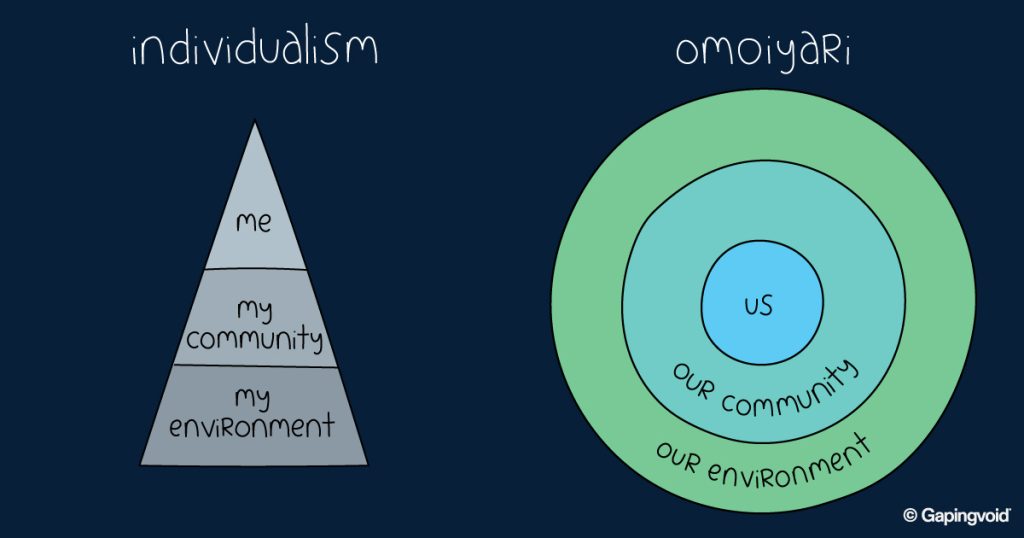
There’s a Japanese word with no English equivalent: Omoiyari. It means something like a deep, reflexive consideration for others that permeates at all levels of the culture.
That the Japanese would have such a word is not surprising, given that they are probably the most culturally cohesive society in the developed world. But what is interesting is why.
Japan is mountainous. Very little flat land. So their staple crop became rice, which needs far less acreage than wheat. But it demands something wheat doesn’t: the entire village. You can’t grow rice alone. One paddy at a time, everyone works together, negotiating who floods which field and when.
So it seems that the reason Japanese have such great manners isn’t so much because of their virtue, but because of environmental necessity.
Thomas Talhelm proved this in a 2014 Science study. What he found was that within the same country, China, with the same government, same ethnic group, and same language family, rice-growing regions produced measurably more collectivist people than wheat-growing regions. In the 1950s, the Chinese government assigned people to two state farms just 56 kilometers apart. One grew rice, and one grew wheat. They had the same policies and the same latitude. Within a generation, the rice farmers were significantly more group-oriented.
Or take the Scandinavians. Their ancestors spent centuries in Viking longhouses with fifty people and their livestock, one structure, and brutal winters. There wasn’t much room for personal drama or squeamishness about privacy. A thousand years later, Scandinavians are still laconic, moderate, and remarkably relaxed about nudity. The longhouse is gone but the culture it created isn’t.
In the Nineteenth Century, adjusted for inflation, for the price of half a Volkswagen Passat, you could head West and grab yourself a price of land and have everything you needed to set up your own farm and be exporting grain within 18 months. The only deal was, on the farm you were on your own. Hence why American individualism and gun ownership are so highly valued in the US today.
Environment shapes reality, which shapes language and culture, which shapes behavior. It’s all connected.
One could reasonably deduce that the reason those of us in the Anglosphere don’t have our own word for Omoiyari is because our environment never demanded one. Language is not only a product of culture, but its creator.
Korean Air had one of the worst safety records in aviation. The problem wasn’t mechanical. Korean has six speech levels encoding hierarchy, and junior officers couldn’t directly challenge captains during emergencies. The fix was to require all cockpit communication in English. Not because English is better. Because it didn’t carry the hierarchical weight. Their safety record since has been spotless.
They didn’t change the people. They changed the language.
Every organization is already doing culture design, but is it on purpose?