If you’ve been living in Europe for a while, one of the first things you notice when you get to the US is how much more processed the food is. The bread. The meat. The fruit and vegetables. It all just seems to have less flavor, more additives.
Processed food started going into overdrive during World War II, when the American military needed food that could be prepared cheap and easily for the front line. Fair enough. But then the idea started spreading to the home front. We all like cheap, we all like convenience, not just the warfighters.
It didn’t happen overnight. It’s not like the Americans woke up one day and said, “Hey, let’s make our food worse.”
It was more of a “death by a thousand cuts” situation. A little cost cutting here, a pinch of additives there. Plus politics, lobbying and technology doing their part.
But do that consistently over a long time, and the results compound. Step by step, decade by decade. Ask any Frenchman about American baguettes if you don’t believe us, or a German about US sausages.
As James Clear wrote in Atomic Habits, “Every action you take is a vote for the type of person you wish to become.”
The same thing happens at scale – to a team, to a town, to a company, to a country.
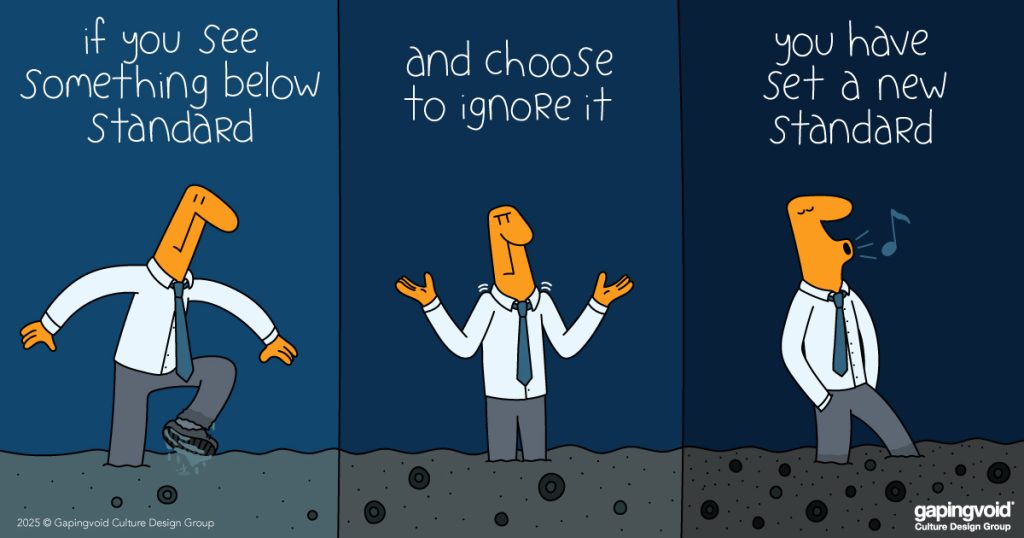
Every action you take is a vote for the new norm you want to establish.
What starts as an exception ends up as an expectation. What begins as a niche practice ends up as a new normal.
That’s just how it works. People see changes being made, see people getting rewarded by it, start imitating it as a matter of course, and the behavior cascades. It becomes normalized.
The good news is, this can also create positive outcomes.
For example, nobody at the software startup declares a culture of recognition into existence. Instead, the CEO sends out an email thanking a team, by name, for great work. That team responds by thanking another team. The next day everyone is quicker to credit one another. And the whole thing snowballs from there.
As a species, people are designed to copy what they perceive to be successful behavior. That’s how knowledge is spread and how norms are established. Not through dictates from above, but by imitation.
And who are they imitating? Why you, Dear Leader. You’re setting the example, whether you want to or not.
As T Swift sings, “It’s me, hi. I’m the problem, it’s me.”
So the question becomes not what actions are you promoting, but what actions are you embodying?
What norms are you reinforcing by your personal behavior? What bad actions are you tolerating?
These are all votes. For the norms you want. For the outcomes you get.
Norms are destiny.