Back in the early 1990s, you didn’t read daily comics online. The Internet barely existed for most people, you read them in newspapers.
If you saw a comic you liked, especially one work-related, you’d clip it out and post it on your office door or cubicle wall.
If people passing by liked it, they’d comment on it, and a conversation would start.
The clipped-out comic became what anthropologists call a “social object.” An object that spawns human interaction. People generally don’t socialize in a vacuum. They need something to facilitate it.
Years before Gapingvoid was founded, our co-founder noticed that at his advertising agency job, tha the vast majority of newspaper comics being posted on doors were Dilbert cartoons. Their poignancy about organizational culture seemed to really hit a nerve.
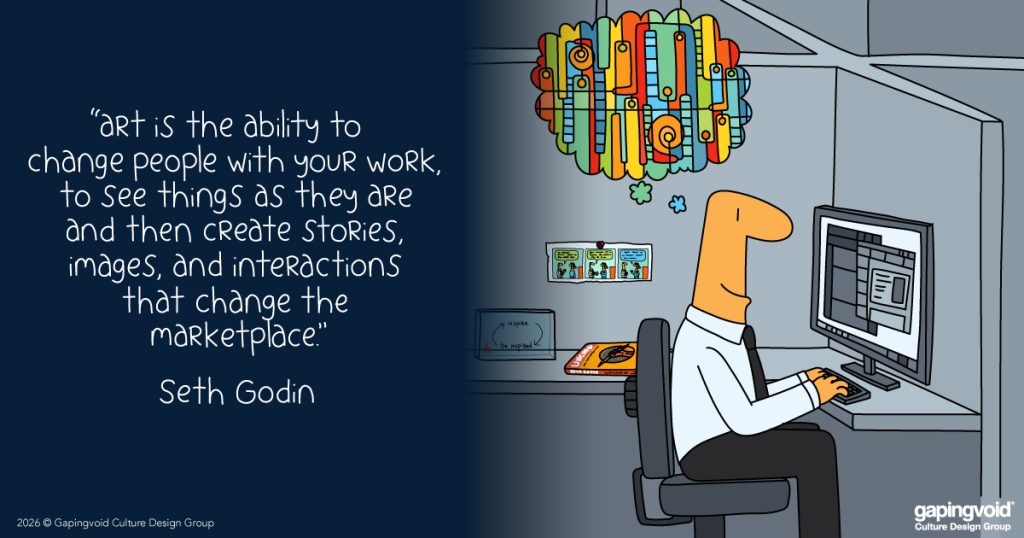
Being a cartoonist himself, he thought this cartoon-as-social-object idea would be a great way to spread ideas throughout an organization. It just needed more focus and relevancy than a general newspaper cartoon.
That insight still drives how we work today.
Scott Adams died on January 13th at age 68. His 2023 fall from grace was sad and unfortunate, but his influence on how ideas spread through organizations was undeniable.
Everyone already knew their workplace was absurd. The pointless meetings. The incompetent managers. The initiatives that existed only to justify someone’s job.
Adams didn’t discover anything new. He just figured out how to say it in a way people could actually hear.
Three panels, a punchline, and no explanation needed.
The form helped the delivery of the message. A cartoon isn’t threatening. You can pin it up, laugh with a colleague, and nobody gets defensive. The medium created permission the message alone couldn’t.
Most leaders think their job is to identify what’s broken. But that’s easy. Everyone sees it.
The hard part is figuring out how to deliver it so people can respond instead of resist.
Say it in a 50-slide deck announcing changes, and you’ll get defensiveness. Say it in a closed-door meeting, you may get silence. Say it in a way that makes it easy to acknowledge and start to explore, and you may get movement.
The container shapes the conversation.
Shakespeare once said “Brevity is the soul of wit.” In our experience, great communication has all three. How you say something determines whether anyone can actually hear it.