The Japanese call this phenomenon “Ma”, which translates into “space,” “gap,” or “interruption.” It’s everywhere in Japanese art, from the emphasis of the silence between the notes in flute playing, to how the white of the paper is every bit as important as the sumi brushstroke in a piece of “Shodo” calligraphy.
Dive a little deeper, and you’ll find this philosophy deeply ingrained into Japanese culture, a lot of which they get from Buddhism, hence the Heart Sutra’s famous idea that “The form is the void, the void is the form”.
Dig even deeper, and you realize Ma is everywhere, Buddhism or no Buddhism.
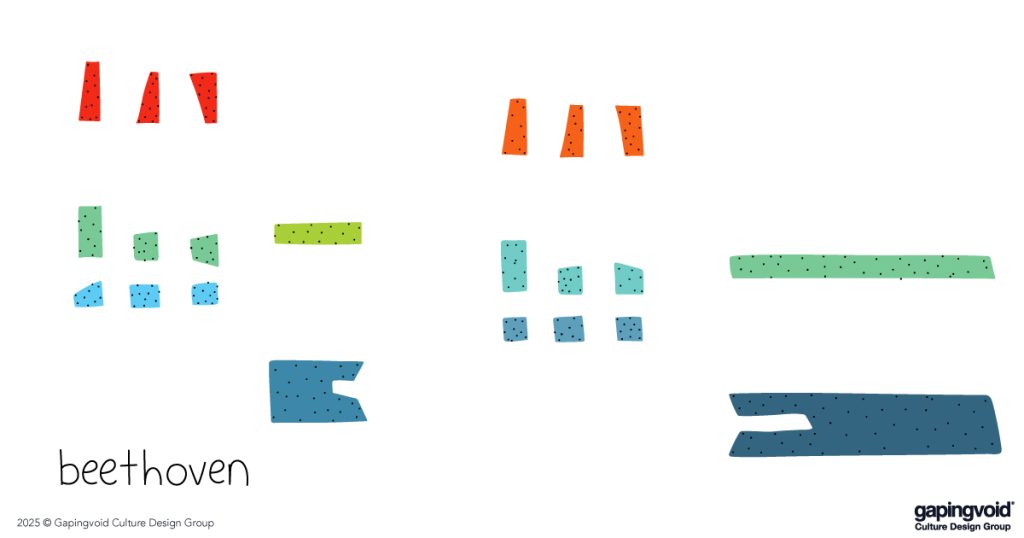
Take the most famous musical phrase in Western Classical music: the first eight opening notes of Beethoven’s Fifth Symphony, broken in half by a distinct pregnant pause.
DOM, DOM, DOM, DOM… DOM, DOM, DOM, DOM…
In artistic terms, Westerners call this “negative space.” It’s when what’s NOT there holds the whole thing together.
Or take what the author, Ernest Hemingway called “The iceberg principle”. when there’s a lot more happening underneath the surface (what is unsaid) than what lies above it (what is said). Something Hemingway was a master of capturing in his spare, minimalist prose.
Or the industrial designer Jony Ive’s seminal work for Apple over the years. The more dials and buttons he removed from the device, the more beautiful the design became.
In a world saturated with distractions, clutter and overstuffed to-do lists, the idea of Ma is the perfect antidote.
In our line of work, we call this state of mind “Creating white space”.
And any organization that pays its bills being innovative needs lots of it.
Most of us have heard it before, but far fewer are actually creating it.
What’s easy for us to forget is that innovation isn’t a sausage machine. It’s not about cramming more into the calendar or squeezing efficiency from every minute. It’s about creating room to breathe. Space to actually think. Permission to pause.
Everything meaningful happens in the spaces between. Love lives between words. Answers sit quietly between calls.
Maybe we keep filling the gaps because we’re afraid of what we might find there. But the gaps aren’t empty.
And they could be full of everything we’ve been looking for.