“Fight Club” (1999), starring Ed Norton (as “The Narrator”) and Brad Pitt (as “Tyler Durden”) is considered one of the best movies of its decade. A real classic.
Even though it bombed at the box office. Even though critics hated it. Even though the cognoscenti said it was full of misogyny, toxic masculinity, and promoted violence.
A dreadful movie about dreadful people doing dreadful things.
And yet.
People discovered it on DVD, and word started to spread. Something stuck. It resonated.
Over time people started discovering it on DVD, and word started to spread. Something really stuck, something really resonated.
Nowadays it’s seen not as a glorification of violence and men behaving badly, but as a critique of late-stage capitalism and consumerism.
How the latter creates a world where every relationship is transactional, where the only meaning comes from buying stuff you can’t afford, stuff you don’t particularly want, just to impress people you don’t particularly like.
As Tyler Durden says in the beginning of the movie, lamenting the materialist hole in his life:
Like everyone else, I had become a
slave to the IKEA nesting instinct.
Yes. I’d like to order the Erika
Pekkari slip covers.
If I saw something like clever coffee
table sin the shape of a yin and
yang, I had to have it.
[…]
I would flip through catalogs and
wonder, “What kind of dining set
defines me as a person?” We used to
read pornography. Now it was the
Horchow Collection.
Tyler Durden later refutes this idea with his famous anti-materialist speech:
“You’re not your job. You’re not how much money you have in the bank. You’re not the car you drive. You’re not the contents of your wallet. You’re not your f***ing khakis.”
And then things quickly spiral out of control. Mayhem ensues (literally “Project Mayhem”), with the film ending (SLIGHT SPOILER AHEAD) on a rather bleak but piquantly ambiguous note.
The morale of the movie? Superficially, one could say “Late Capitalism Bad.” But as the movie implies, if you tear down that system, all you do is create a new one that’s probably worse. Destroying a civilization is a lot easier than building one.
Fine. But we think the film folk missed a much simpler, more obvious point. Arguably including the filmmakers themselves.
Because the story is told through The Narrator’s perspective, it’s easy to relate to his point of view, his framing of the situation.
Yes, he hates his job, his life, his apartment, his IKEA furniture, his general numbness to the modern world. Who wouldn’t?
But what The Narrator never does is ask himself if maybe the problem isn’t late-stage capitalism. Maybe the problem is him.
When the movie opens, The Narrator is not committed or accountable to anyone, or anything. Not at home. Not at work. Instead of building a real life with a real person, he ends up with Marla, a crazy, unstable woman brilliantly played by Helena Bonham Carter. Even Tyler Durden, the only true friend, turns out to be imaginary.
Isolation became hallucination.
Coming home to an empty apartment full of IKEA stuff doesn’t make people happy. Coming home to a family and eating dinner together makes people happy. Planning the overthrow of society with a bunch of lost, angry, resentful, desperate souls doesn’t make people happy. Reading kids a bedtime story (or yourself for that matter) makes people happy.
Same with his job. He has no real relationship with his boss, his colleagues, or any connection to the actual work itself. But you never see him try to create one. No sacrifice. No sense of purpose. No “I’ve got your back.” No empathy for other people, no real desire to fix a real problem for anyone other than himself.
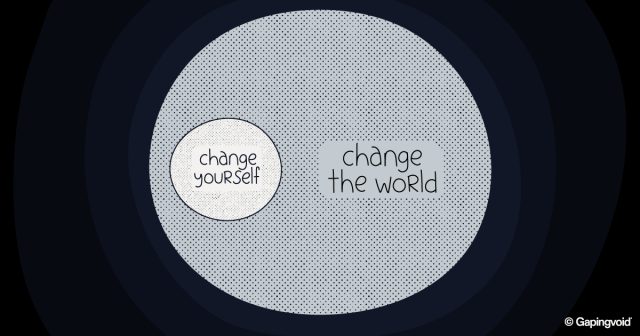
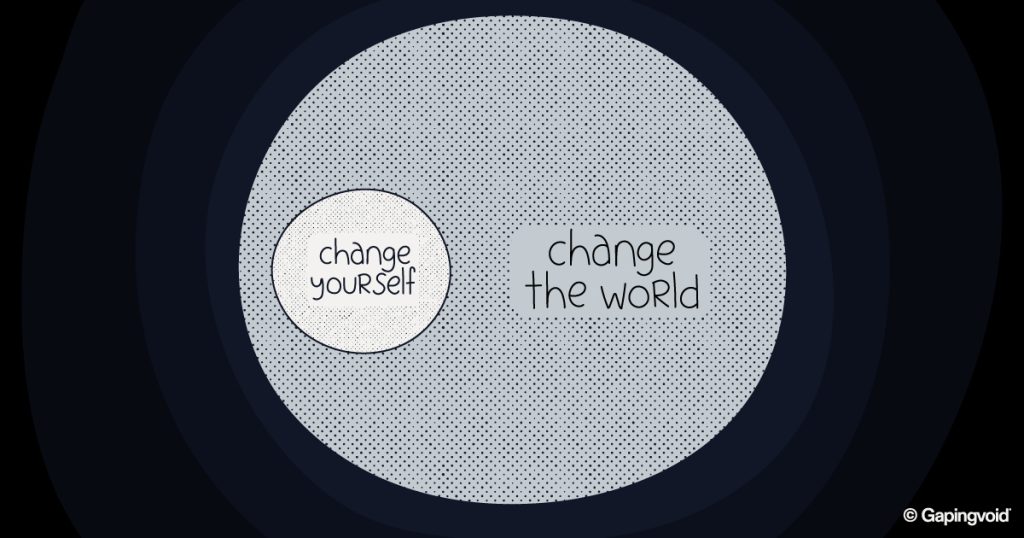
The Narrator ends up going to extraordinary lengths to change the world. It never occurs to him for an instant to change himself.
And that’s where people get stuck. That’s where businesses get stuck too.
Fight Club is a great work of art. A truly great critique on a really massive problem.
It just never addresses the actual problem.
Which, of course, is us.