So you want to be a millionaire.
Easy. Just put $X dollars a day into a low-cost index fund. Repeat every day for a few decades.
That’s it. Seriously.
Day by day, every day, no matter what the day brings.
The economy just entered a recession?
Put $X dollars into the stock market.
The market is soaring and hitting new highs?
Put $X dollars into the stock market.
The dollar just tanked and the market corrected down by 15%?
Put $X dollars into the stock market.
Morgan Housel, author of The Psychology of Money, argues that this strategy – called “dollar cost averaging” – is mathematically proven to beat any attempt to ‘time’ the market.
Valentino Garavani, the Italian designer who launched a fashion empire, recently passed away.
Over the course of his career, he was known for being famously, stubbornly consistent.
He believed fashion should ennoble, not shock. Not provoke. Elegance was his goal. He had a few core signatures, like a particular shade of red (which came to be called “Valentino red.”) When fashion turned toward minimalism and/or shock value for a few decades, he didn’t follow the bandwagon, he stayed the course.
Day by day. Decade after decade. Cultural deposit after cultural deposit.
The old slow n’ boring.
There may have been moments when he felt like shifting style. Like “selling” and “reinvesting” elsewhere. But he didn’t. He didn’t chase the shiny new thing, he didn’t “panic sell” when his approach seemed unpopular, he made his daily deposit. In the end, it made him legendary.
Everybody’s looking for the new quick n’ sexy. None of us want to hear about the old slow n’ boring, even if the latter is statistically far more likely to work.
Perhaps we should take a lesson from Valentino.
There’s a famous story about a new Kung Fu student talking to his Master.
“Sifu, how long will it take me to become a master?”
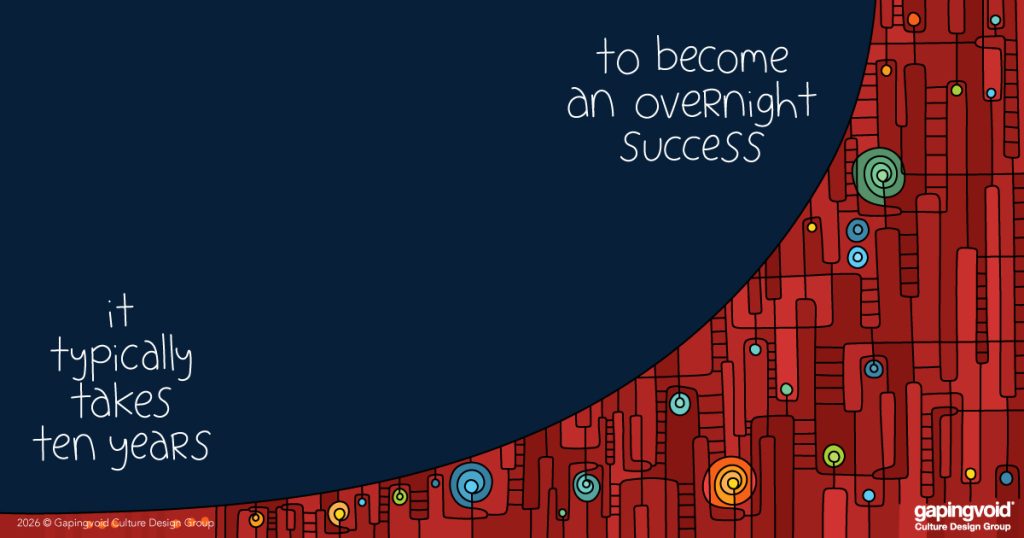
“Ten years.”
“But what if I train twice as hard as all the other students?
“Twenty years.”
“But what if I train twelve hours a day, giving up everything else?”
“Thirty years.”
The master was pointing to the thing we keep trying to outsmart: there is no shortcut to compound interest.