In February 1940, five months into World War II, just before he became Prime Minister, Winston Churchill was First Lord of the Admiralty.
Germany had blockaded Britain’s supply lines in the Atlantic. Churchill later stated that it was the only major battle of the War that really kept him up at night, that really posed an existential threat to Great Britain.
A Cabinet Secretary asked the Director of Naval Intelligence for a plan to defeat German U-boats. The Director delivered a four-page report. Churchill read it and sent back a memo: “On a single piece of paper, state how you propose to win the Battle of the Atlantic.”
The Admiral replied with two lines:
- Build more convoy escorts.
- Improve radar and depth charge technology.
And that’s pretty much what happened. Talk about the power of brevity.
By 1943, the German U-Boat fleet was a defeated entity, giving the Allies a full year to prepare for D-Day. Churchill’s talent for brevity forced clear thinking amid the fog of war. And so it goes, whether at war or leading an organization. A recent example of this in real life was an experience over at DARPA’S Bio-tech Office (BTO), led by Dr. Mike Koeris.
Koeris had a vision for transforming the office. He wasn’t interested in incremental improvement. He sought to create a genuine departure from how things had been done.
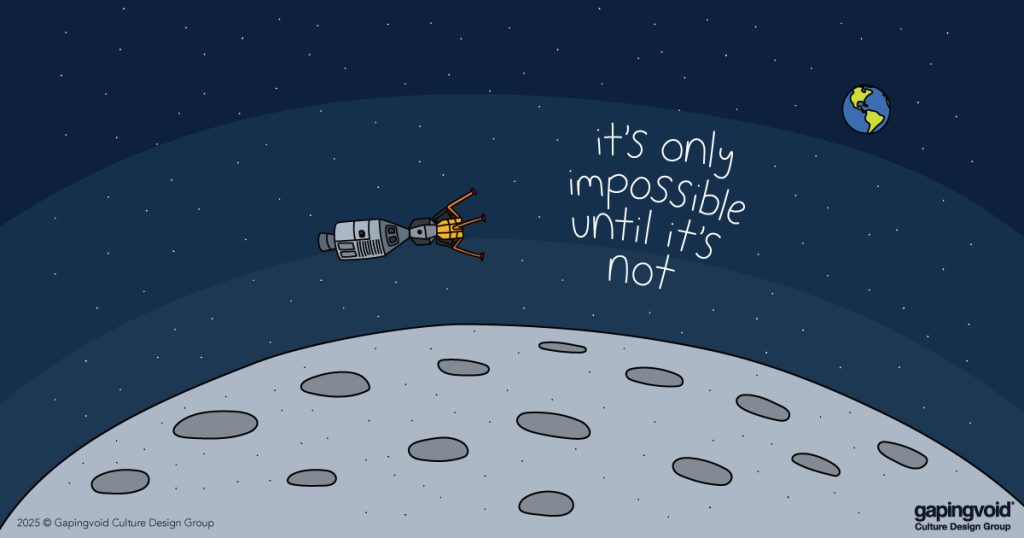
With help from Gapingvoid, he codified that vision into a strategy and culture built around speed, intensity, and hyper-collaboration. An organization focused not on incremental research but on world-changing science. In short: a place where people make the impossible, possible.
Delivering that vision required a human transformation as much as a technical one. You can’t just announce new values and expect people to change. You have to shift what people believe.
And belief doesn’t shift in a memo, it changes in moments.
So we designed a big moment. Not focus groups or an email, but something that showed people how these new beliefs could live in their day-to-day work. A launch of a new way of looking at the office and the work and each other. Something that emotionally connected them to the mission.
The event sparked the transformation and lit the torch. But every torch has to be carried.
You can start a cultural transformation with a single event. You just can’t finish one that way. The event creates the opening. What follows is the real work: sustaining belief through action, every day, until it becomes the way things are done around here.
Churchill knew this. After El Alamein, Britain’s first major victory over the Axis, he told the nation:
“Now this is not the end. It is not even the beginning of the end. But it is, perhaps, the end of the beginning.”
Sparks are easy. Fires take tending.