“Let us agree,” said the North Wind to the Sun, in one of Aesop’s fables, “that whoever can strip that traveler of his cloak is more powerful.”
The Sun agrees.
Mr. North Wind is up first. He sends gust after gust at the traveler.
No luck. The traveler just pulls his cloak tighter.
Sun’s turn. He shines his warmth onto the traveler, and the traveler takes off his cloak on his own.
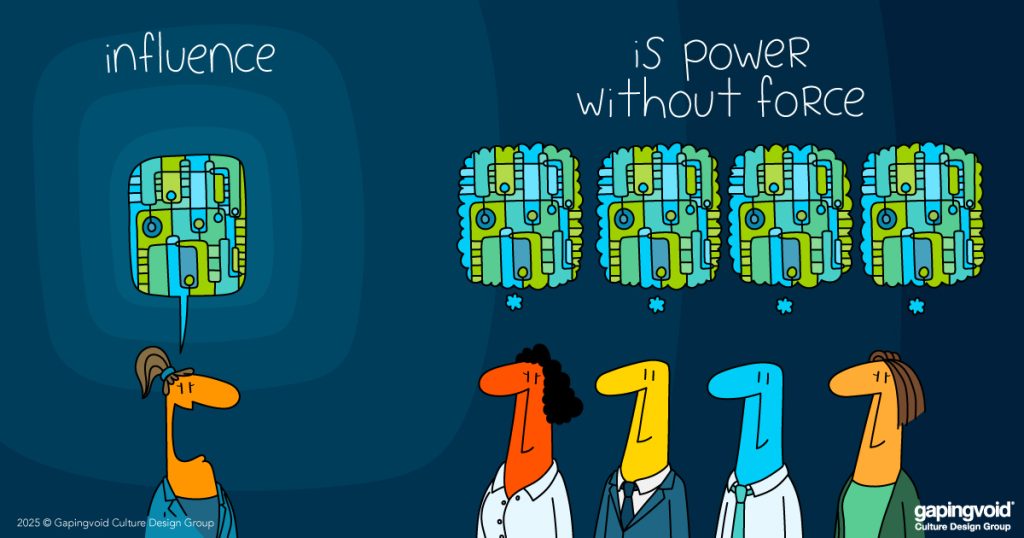
This is the difference between force and power.
Force tries to compel change. Power motivates people to move on their own. Force is command-and-control. Power is persuasion, inspiration, influence.
Leaders, executives, fancy-title holders tend to have force because of their position.
Some of them also have power. But not all. Maybe not even most.
That’s good news for people who aren’t in formal positions of leadership. You don’t need to be top dog to have power or change things. Force comes from the org chart. Power comes from skills.
When Gapingvoid launched a leadership masterclass for DAF PEO C3BM this year, the goal was to teach those skills to 100 managers and leaders, teaching them to lead through cultural influence rather than traditional command structures. Through power, not force.
In a previous Masterclass for the Digital Transformation Office of the U.S. Air Force, 93.5% of participants reported becoming more effective leaders and improving daily mission execution.
Through the course, C3BM leaders gained clarity on their leadership philosophies, began to understand outdated thinking patterns, adopted tools like semiotics and feedback frameworks, and learned framing techniques that participants called “massive” in impact.
Months later, participants are still using these skills in meetings, applying cultural frameworks to operational decisions, and approaching challenges with renewed clarity about the “why.”
This matters. Force is an unsustainable way to build a movement, a culture, a company. Power is what counts.
And power is earned person-to-person, not bestowed by a title.
In the Ancient Roman conflict between Caesar and Pompey, Pompey had the force. He had legal authority, money, the official army, and the big title. Caesar had a small but fiercely loyal and devoted army.
Pompey relied on formal authority: force. Caesar relied on his connection to his soldiers, his ability to win hearts and minds: power.
We know how that story ends, but the same story plays out thousands of years later in all of our lives.
In November of 2023, Open AI’s board fired Sam Altman. They had the legal authority, corporate control, and formal right to do it.
Then the letter happened.
700 of OpenAI’s ~800 employees signed a letter saying: Bring Altman back, or we all leave.
Altman had the power: the person-to-person relationships that actually change things.
That’s usually how it goes.
Force tries to stretch an organization where it doesn’t want to go. Eventually, the rubber band breaks.
And that’s when it’s revealed who really had the power all along.
There will be surprises.