You’ve probably seen headlines like these in the last year or two:
- Wall Street Journal: “Even Harvard M.B.A.s Are Struggling to Land Jobs.”
- Fortune Magazine: “Delta’s struggles with the airport lounge and the angst of the upper middle class in the age of ‘elite overproduction,’ explained.”
- From El Pais: “Luxury isn’t what it used to be: What’s happening to the world’s most exclusive brands?”
It’s an easy enough problem to understand. We’ve gotten really good at creating elites. We’re not that good at creating economies to sustain them.
But it’s not just MBA’s, frequent fliers and $7,000 handbag makers. Every business faces this problem.
Too many cars, not enough drivers. Too many art galleries, not enough collectors. Too many restaurants, not enough diners. And on and on.
We live in a world of oversupply where most markets are standing-room-only.
And that’s before we factor in what AI might do.
The good news is, you probably already know this, and if you’ve been smart, you’ve already been making a plan.
What’s the plan?
The same plan we’ve been making for countless millennia: “When others zig, zag.”
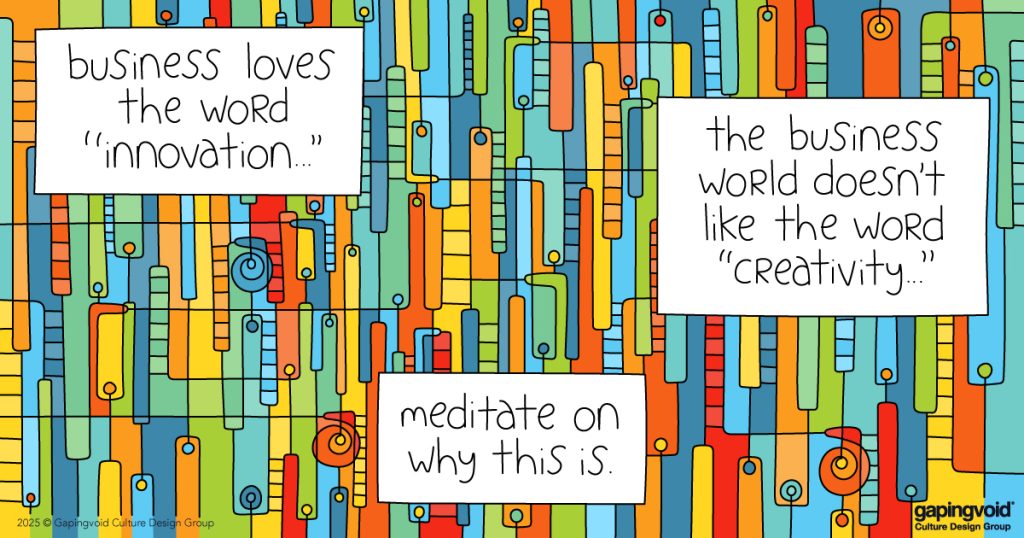
Or, to quote Satya Nadella when he took over as Microsoft’s CEO back in 2014: “What the world rewards most is innovation.”
It’s true of course. The trouble is, innovation is not a thing, it’s just the product of other things. We can’t just pop into Innovations-R-Us and order it by the yard.
Innovation is something that only comes after the real work is done. And the real work is creativity which is upstream from innovation. Always.
A lot of people in business cringe at the word, “creativity.”
It’s vague, it’s overused, it’s a word more often associated with flakey artsy types than hard-nose movers and shakers trying to get things done.
But it doesn’t matter if you dislike the word or not, you’re basically dead without it.
Which means you need to build a culture that knows how to harness it to your advantage.
Even if AI becomes more creative than us one day, at least in the idea generation department, we still have to know what to do with all that creativity.
And have teams that know which three ideas out of 10,000 actually matter.
So yes we can debate whether creativity belongs in quarterly reports, but it’s far more strategic to focus on building organizations that know how to harness it.