Plato – ever heard of him?
Of course you have. He’s arguably one of the most impactful philosophers who ever lived.
Without getting into the metaphysical weeds, one of his more contested ideas is that the ultimate reality is a realm of ideas, not our realm of concrete things.
We moderns tend to think of concrete things as primary, and ideas as secondary.
Platonism flips that. The idea of the perfect house, horse, pot, or person came first, and the many concrete houses, horses, pots, and people are just copies. Those original perfect ideas are called “Platonic ideals.”
We’ll leave the merits and demerits of Platonism to the philosophers. What we do know is that great leaders, visionaries, and movement-makers operate like cultural Platonists.
Here’s what that means practically…
Imagine a project manager at a large tech company. He’s fixated on shaping his people’s concrete actions. He obsesses over getting them to act a certain way, and he does it by talking to them about actions. Requesting actions. Adjusting actions. Demanding actions. All day long. People do what he tells them to because he’s the boss. But the moment the demands stop, the actions stop. He’s not a cultural platonist.
He tries to change the system’s outputs (actions) at the level of outputs. It works in small pockets but he doesn’t change much in the grand scheme of things.
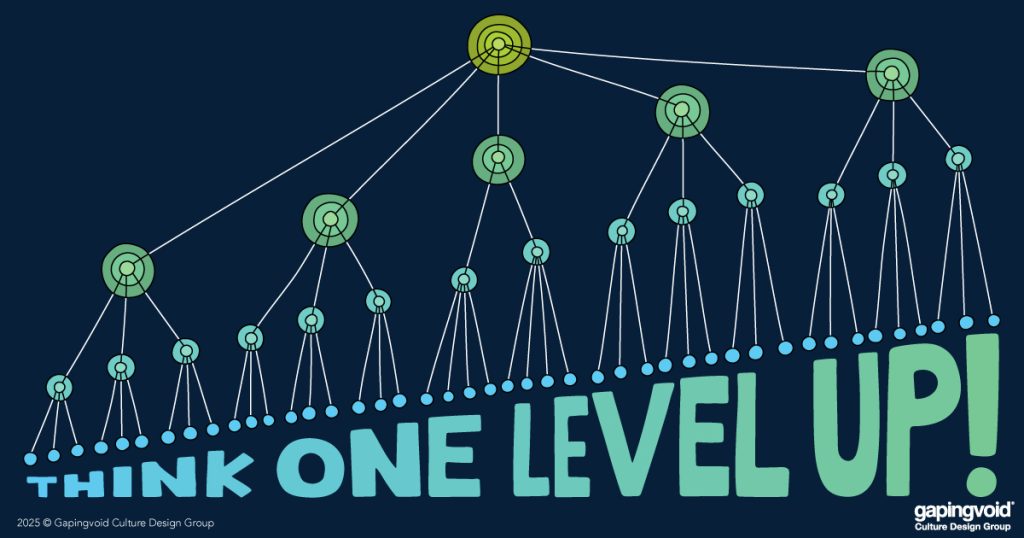
Imagine a different leader. She’s a team lead at a nonprofit. She wants to drive concrete actions, but she doesn’t do it at the level of actions. She goes up a level. She’s all about beliefs…
Why certain ways of doing things are better than others. What big-picture principles her team is all about. The moral value of the work. Stories about the people helped, the lives changed, the pain healed.
She gets the beliefs right (the ideas) and the right actions naturally follow.
She tries to change the system’s outputs (actions) at the level of inputs: beliefs. And it works.
As Wayne Dyer, known by some as the Father of motivation said, “If you change the way you look at things, the things you look at change.”
Productive thinking is primary. Productive action is a consequence. Good ideas first. Concrete action second. It’s sort of like Platonism.
This week, as the UN marks its 80th anniversary, this idea becomes more urgent.
In New York, global leaders are gathering for what they call “High-level Week” – featuring an “SDG Media Zone,” a “Goals Lounge” for “deep dives into vital issues,” and a Climate Summit where leaders will “present their new national climate action plans.”
More solutions. More action plans. More commitments.
But the statistics ain’t looking good.
According to the World Economic Forum, “Only 18% of the Sustainable Development Goals (SDGs) are on track, with nearly half progressing too slowly and close to a fifth even regressing.”
After 80 years of this approach, maybe it’s time to ask: are we working at the wrong level entirely?
These goals tackle wicked, weighty problems. These are complex systems, complex outcomes like systemic inequality, poverty and healthcare.
The question we’re asking is, is the UN operating like an ordinary change-maker or like a cultural platonist?
Are they trying to change action at the level of action? Or are their leaders first examining the beliefs around them and thinking about how to change them in a way that spreads?
We don’t know the answers, but these questions are worth asking.
Eight decades in, perhaps it’s time to think about whether we’ve been focused on the wrong level entirely.
Cultural platonists understand that you can’t institutionalize what hasn’t been internalized.
Gandhi said: “If we could change ourselves, the tendencies in the world would also change. As a man changes his own nature, so does the attitude of the world change towards him.”
Most of us fixate on actions. Few go up a level to think about the beliefs that underpin those actions and how to build systems that amplify different ones. But that’s where the leverage is.
It’s a simple concept. It’s much harder to do.
As everyone is adding more action items this week at the global level, maybe it’s time to go upstream and examine how to change the belief system first.