Have you ever heard the old thought experiment about the indecisive donkey?
A donkey is equally thirsty and hungry. He’s placed halfway between a pile of hay and a pail of water. What happens? Does he choose randomly?
As philosopher Jean Buridan opined about human choice in 1340:
“Should two courses be judged equal, then the will cannot break the deadlock.”
As satirists parodied, according to Buridan’s logic, the donkey wouldn’t be able to choose anything – and despite being in reach of both water and hay, he would die of starvation or of thirst.
A piece of dialogue from the critically acclaimed show Mad Men gives the lie to Buridan’s theory.
Don, the accomplished advertising executive, was talking to Peggy, one of his mentees in the business. Peggy was stuck trying to choose one of two angles for a pitch to a client.
The problem? They were both good, and they were different enough to get different reactions from the client, yet similar enough that the choice felt impossible.
Peggy asked Don how he managed not knowing which angle would win the client.
His answer?
“You have to live in the not-knowing.”
Basically, he didn’t manage the ‘not-knowing’ at all. He accepted it. He embraced it. He lived with it.
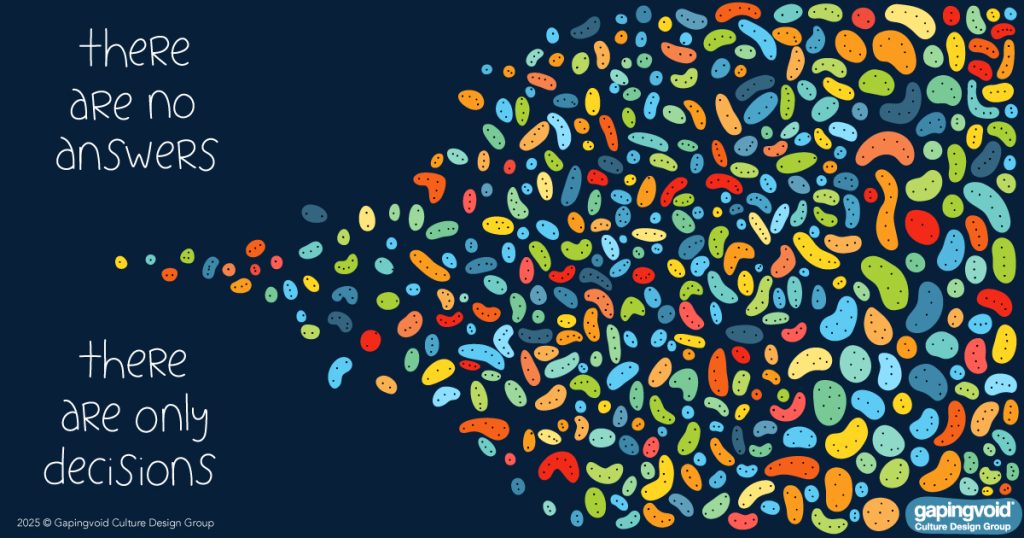
And that’s one of the most underrated secrets of high performing individuals and high performing cultures. Living in the not-knowing. Getting comfortable in the uncomfortable. Realizing the scary yet liberating truth that everything is improv.
In his book The Song of Significance, Seth Godin talks about what he calls “liminal” spaces. Spaces in between input and out, effort and reward, attempt and success – or failure. Spaces of not knowing.
Not knowing if the commitment and the energy will yield results or fall flat.
Not knowing if the project will pan out or if the client will call it off.
Not knowing if going all in and giving 100% will be rewarded or ignored.
Here’s the secret: Anyone striving for any sort of success has to stand in one of those liminal spaces – those spaces of uncertainty.
The only way to avoid them is to opt out of the game, but that comes with its own consequences.
If you decide to play? Then you might as well know what sort of game you’re playing.
There are those who think they can find certainty and escape the limits of the liminal, perhaps by building a business big enough, or by finding a technology unique enough, or crafting a team committed enough.
But big businesses break too. Groundbreaking tech gets replaced eventually. And a committed team? That’s the product of culture – and culture is an infinite game.
There are also those who realize that uncertainty is illusory and unattainable. They sail for ports they cannot see, ports that might not even exist. Knowing they have to take risks anyway, so they may as well take bold ones.
If you choose to play the game, the question is which kind of player will you be?
Will you let the not knowing break you?
Or will you learn to live in it?