At some point in our lives, we all feel stuck. Stuck in our lives, stuck in our careers, stuck in our marriages, stuck in our mindsets – wherever.
So we decide to turn it around. We decide the only thing that’ll pry our lives out from the jaws of quiet desperation is something big and dramatic (SFX: BOM BOM BOM BOM…).
This could mean anything. Climbing Mount Everest. Cycling across Europe. Sailing across the Atlantic. Drug-infused shamanitic rituals in the Brazilian rainforests. Walking the Camino trail. Buddhist pilgrimages to Tibet. Kung Fu trips to the Shaolin Temple. Oil painting courses in Paris. Digging water wells in Mali.
Sounds great.
The problem is reality.
Just because you found God on a mountain top in Bali doesn’t mean He’ll still be around once you get back home to Cleveland. Your trip to Peru might have put your confronting problems on hold for a spell, but they will still be waiting for you once you’re back in town.
Buckaroo Banzai’s “no matter where you go, there you are.” And all that.
The truth is, people don’t change their lives by changing their lives suddenly.
According to Sean Achor, former Haravard professor and Author of “The Happiness Advantage,” the best way to change your life is to change your habits.
This means, start by doing little things. Nothing too dramatic, just wee improvements, many and often. Start exercising. Spend less time staring at your phone. Read more books. Eat less crap between meals. Don’t leave the house in the morning without making your bed. Quit those lousy cigarettes, or at least, start cutting down.
The science says it takes between three and six weeks to turn a healthy move into a habit, and often you don’t manage it the first time. So keep on trying. Eventually something will click.
But you know all this already. It’s the same stuff Granny would’ve told you.
The interesting thing is what works for individuals also works at the organizational level.
Real change (the kind of positive and lasting change that actually works) at the enterprise level doesn’t happen with a stroke of a pen, a big speech, or a strongly worded memo from the CEO.
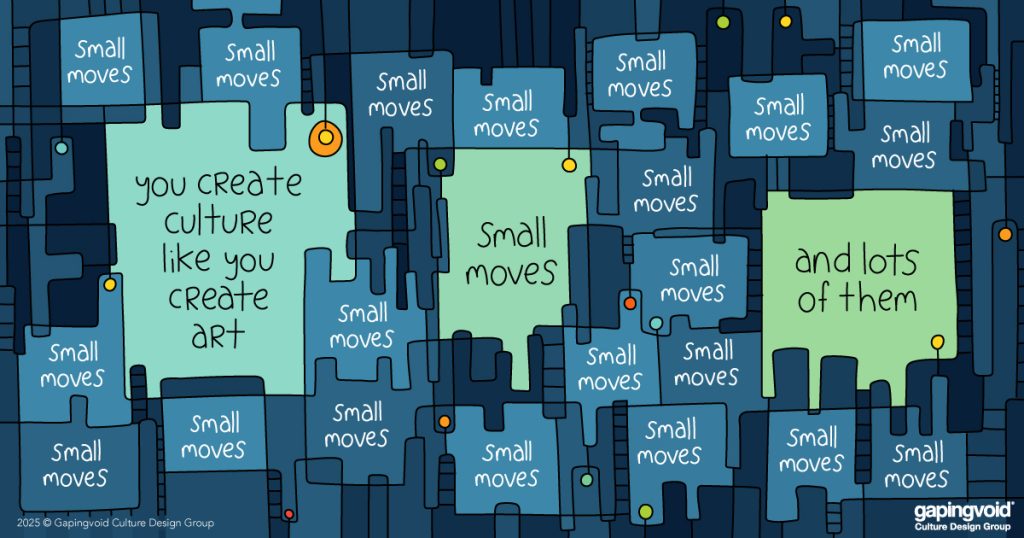
It happens at the granular level. One small move at a time. Limiting meetings to twenty minutes. Remembering people’s birthdays. Staying aligned with company principles by telling people often what those principles actually are.
Sure, it’s the leader’s job to create the vision and mission, have a North Star, and to guide the whole process along.
But like individual transformation, it doesn’t happen overnight. It’s an infinite game.
Because life is an infinite game, right? And infinite games are never won, they’re played.