May 14, 2004

the best advertising strategy is one that gives a damn

hughbizcard.jpg

Gary Turner blogged my day job bizcard. Thanks, Gary!

When I was in London I popped up to Kettering to pay him a visit. Some of the things my company is doing is similar to what his company is thinking about, so we had lots to talk about.

Instead of printing my name on the card, I doodle on the blank bit with a matching drawing. So every bizcard I hand out is "an original". I dunno, I think it works in its own way.

Gary made an interesting point:


I think, and I haven't thought about this much at all, that blogs will inhabit a defined space in meaning in much the same way as you inherently know what to expect when you see some writing entitled 'Press release' or a brochure or an investors statement. There's a chance that when you see a blog in any context, business or not, people will come to recognise it as another standalone genus of communication but one which delivers communication that is honest, full of voice and not over-formal or unstilted.

I think Gary's right. Blogging will evolve into a powerful medium simply because blogs like how he describes are actually read, ones that aren't are completely ignored.

Good advertising and communication is only possible when it's talking about something that actually matters to the person paying for it. Which is why the best communicators are often entrepreneurs.

Good advertising doesn't cure all problems, but it's a really good indicator of whether the people involved actually care about what they do. And companies where the average worker doesn't give a damn are going to find it harder and harder (and harder! and harder!!!) to compete with companies that do.

The best advertising strategy is one that gives a damn.

If you want to know more drop me an e-mail: hugh at gapingvoid etc


Posted by hugh macleod at May 14, 2004 12:59 PM | TrackBack
Comments

It's impossible to know what is good advertising, before it actually turns into "good advertising". Cuz "good" is the measure of the response, not of the concept or execution. And you don't control the effects, since it's chaos out there.

So, advertising is not an art, even less a science. Advertising is a bet, based on intuition.

Oh... And I work in advertising.

Posted by: Valupi at May 14, 2004 10:14 PM

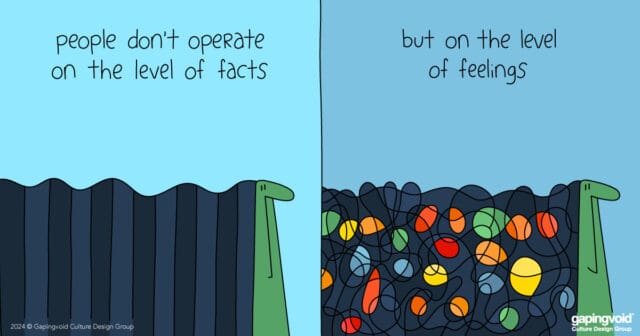
The catch in advertising is that what drives us is not our rational brain but our whole human arsenal of emotions and thought.

And our only way of understanding that is through the risktakers...

Posted by: Jozef at May 15, 2004 3:55 AM

I agree. Advertising is only as rational as the human psyche is rational- which isn't saying much.

Posted by: hugh macleod at May 15, 2004 11:39 AM

I disagree. The catch in advertising, if you allow my arrogance Jozef, is that what drives us is always rational. We can't get out from rationality, either in emotions (they have a logical dynamic, they follow a path, they are predictable, etc.) either in subconscious or unconscious dimensions (which were exposed as rational structures by Freud, just to say one name in thousands, for example).

We have a rational being - better, we have a rational body. Those divisions (mind/body, spirit/matter, reason/emotions, you name it) are rhetoric; and old, very, very old... The truth about human beings is that what we call "reality" is nothing but a rational vision and texture.

To bring the question down to earth, let's see the Bernbach case. When he made the VW campaign, back in the fifties, introducing the "Think small" concept, and redefining advertising for ever, we was not being a genius, simply being the first to explore a new paradigm of communication. Since than, pieces of advertising much more complex and profound have been made, without the same impact. The point is: because Bernbach introduced a new thought, people could understand it and replicate it and build over it.

The same with blogs, which are new and, therefore, exciting. Only, we don't know exactly why and for how long they will continue to please. Making assumptions about communication models is a lottery. Yes, just like advertising.

In conclusion, risktakers (as you so well said) are the ones who find rationality in themselves - specially a new kind of rationality, if they want to change history or make good money. After all, advertising is about making money, no pun intended...

Posted by: Valupi at May 15, 2004 3:44 PM

Yes, true, but.......
Every blog is an advertisement for that person. Even when it's presented with the "This is just my crappy, boring, useless ramblings" approach (there's a lot of that about) it's still advertising and we are all checking our stats several times a day to see if our " product" is selling. So, the blogosphere has become almost a mirror-image of the 'real' world dominated by commercial advertising, except that bloggers are not making money from it. (Well, I'm not anyway ). But the competitive ethos is very much in evidence, what with who's an A-lister and who's not and how many are linking to you and vice versa. etc. etc.

Hugh, I'm sorry we didn't get to talk at the bloggers meet and only exchanged cards. maybe there'll be another occasion?

Posted by: Natalie at May 16, 2004 3:47 PM

i hope you don't mind, but i used 'gaping void' as the title for one of my poems, it just says so much, worked perfectly for where i was going. so i really just wanted to say thanks for the inspiration....Thanks

Posted by: devon at May 17, 2004 2:12 AM

Loved your card idea I'm going to use that now when I print next business card and have it third in print and two thirds in painting!

Posted by: Jenny Price at May 17, 2004 3:24 AM

heh. glad the words "gaping void" came in handy...

Posted by: hugh macleod at May 17, 2004 9:24 AM

So Valupi, you never got back to Stryker on the post-modern issue...not satisfactory.

Posted by: A spectator..... at May 19, 2004 8:11 AM

Some interesting ideas, Valupi...

"Knowledge" in the affairs of men is never 100%.

I'm messing around with some "flexible" models... on the basis that the definition of good marketing design is "managing the gap between what you want people to do and what they end up doing."

Posted by: hugh macleod at May 19, 2004 9:33 AM

From our blog…
Creative has at least something to do with it
Here's super, super creative Hugh Macleod's take at his super, super cool blog Gaping Void. We've talked a lot about media issues etc. contributing to the decline of standard advertising. Maybe the the value proposition is just off? But clearly creative has something to do with it. Too much is just plain boring, repetitive, pandering, forced, vapid, cloned from someone else's efforts, or just bad.

If you never notice an ad, it's pretty hard to be effective no matter where it's placed.

Posted by: johnza at May 19, 2004 3:33 PM


Please email me about "What is advertising strategy and how one has to brief to the copy writer and visualiser about the strategy. Please email in detail with example.

Regards

V.Sankar

Posted by: sankar at October 28, 2004 10:48 AM

best advertising strategy could only be derived from the behaviours etc. of the your target public. Thnx to my profession, I can smell a minor change in the trends because these trends are based on changing behaviours, and I can read a change in the psyche of my target audience.

Posted by: Rashed at December 24, 2004 5:56 AM